Achieving BNR Through AGS: What Becomes Possible
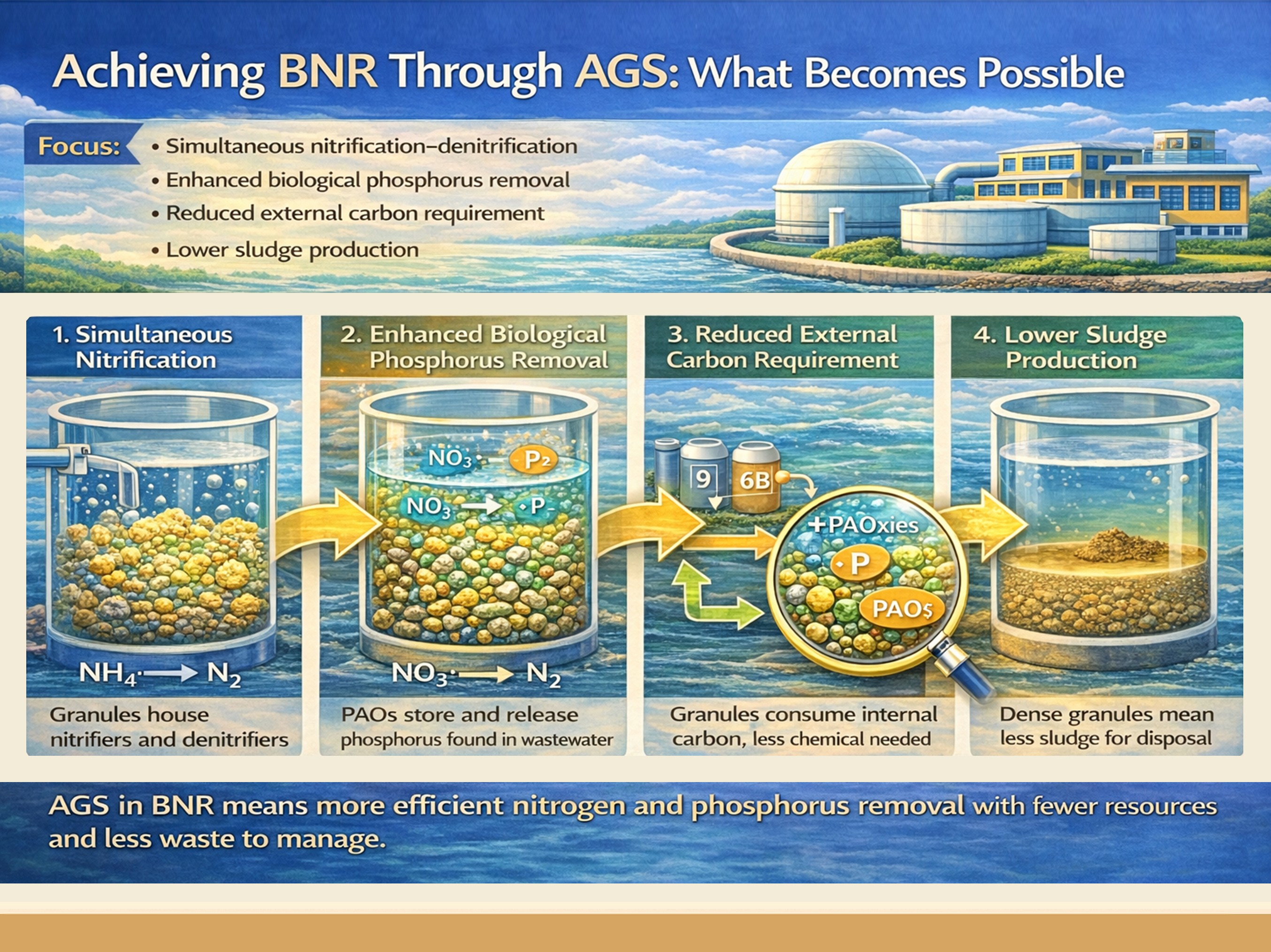
Once aerobic granular sludge is established within an SBR framework, Biological Nutrient Removal moves from being an operational challenge to a structural capability. Unlike conventional systems that struggle to balance competing biological requirements, AGS-based systems are inherently aligned with nutrient removal pathways. As explained in Article 8: How the SBR Process Creates the Ideal Environment for AGS Formation, granulation is not just a change in biomass form—it fundamentally expands what the biology can achieve.
Simultaneous Nitrogen Removal Becomes Feasible
One of the most significant outcomes of AGS is the ability to achieve simultaneous nitrification and denitrification within a single reactor. The aerobic outer layers of granules support nitrification, while the anoxic cores enable denitrification using internally stored carbon. This spatial separation removes the need for complex internal recycle streams or dedicated anoxic tanks.
This capability directly addresses the nitrogen removal pathways described in Article 4: Understanding BNR Pathways — Nitrogen and Phosphorus Removal Explained.
Improved Phosphorus Removal Stability
AGS supports robust biological phosphorus removal by maintaining stable anaerobic and aerobic cycling at the granule level. Phosphorus-accumulating organisms benefit from the feast–famine conditions created during SBR operation, enabling consistent phosphorus release and uptake.
Because these conditions are structurally embedded rather than operationally forced, phosphorus removal becomes more predictable and less sensitive to short-term fluctuations.
Reduced Dependence on External Carbon
Conventional BNR systems often require external carbon dosing due to premature carbon consumption or poor phase separation. In AGS-based systems, carbon is more efficiently captured, stored, and reused internally. This reduces or eliminates the need for supplemental carbon sources, lowering operating costs and simplifying plant management.
This outcome reinforces the importance of carbon preservation discussed earlier in Article 2: Beyond BOD — Why Modern Sewage Treatment Must Address Nutrients.
Lower Sludge Production and Better Solids Handling
AGS systems typically produce less excess sludge due to higher endogenous respiration and more efficient substrate utilisation. The dense structure of granules also improves sludge dewaterability, reducing downstream handling and disposal challenges.
These advantages contribute to both economic and environmental sustainability over the plant lifecycle.
Enhanced Process Stability Under Variable Condition
Granular sludge systems demonstrate strong resilience to hydraulic and organic load variability. The physical integrity of granules protects microbial communities from shock loads, while rapid settling prevents biomass loss. This stability is particularly valuable in decentralised and space-constrained installations, where influent variability is unavoidable.
This resilience directly addresses the influent behaviour described in Article 1: From Toilet to Treatment — Understanding Domestic Sewage Characteristics.
Energy Efficiency Through Targeted Aeration
Because AGS-based BNR relies on controlled aeration rather than continuous oxygen supply, overall energy consumption is reduced. Oxygen is delivered where and when it is biologically useful, rather than as a blanket input.
This targeted approach contrasts sharply with the energy-intensive practices described in Article 5: Why Conventional Activated Sludge Struggles with BNR.
Simplified Plant Configuration
By enabling multiple biological processes within a single reactor, AGS reduces the need for multiple tanks, internal recirculation systems, and complex piping. This simplification lowers capital cost, reduces footprint, and improves long-term maintainability.
By enabling multiple biological processes within a single reactor, AGS reduces the need for multiple tanks, internal recirculation systems, and complex piping. This simplification lowers capital cost, reduces footprint, and improves long-term maintainability.
BNR Becomes a Built-In Capability
Perhaps the most important outcome of adopting AGS is that BNR becomes intrinsic to the system rather than an added requirement. Nutrient removal is achieved through biological structure and process sequencing, not constant correction or operator intervention.
This distinction marks the transition from reactive treatment to resilient design.