How the SBR Process Creates the Ideal Environment for AGS Formation
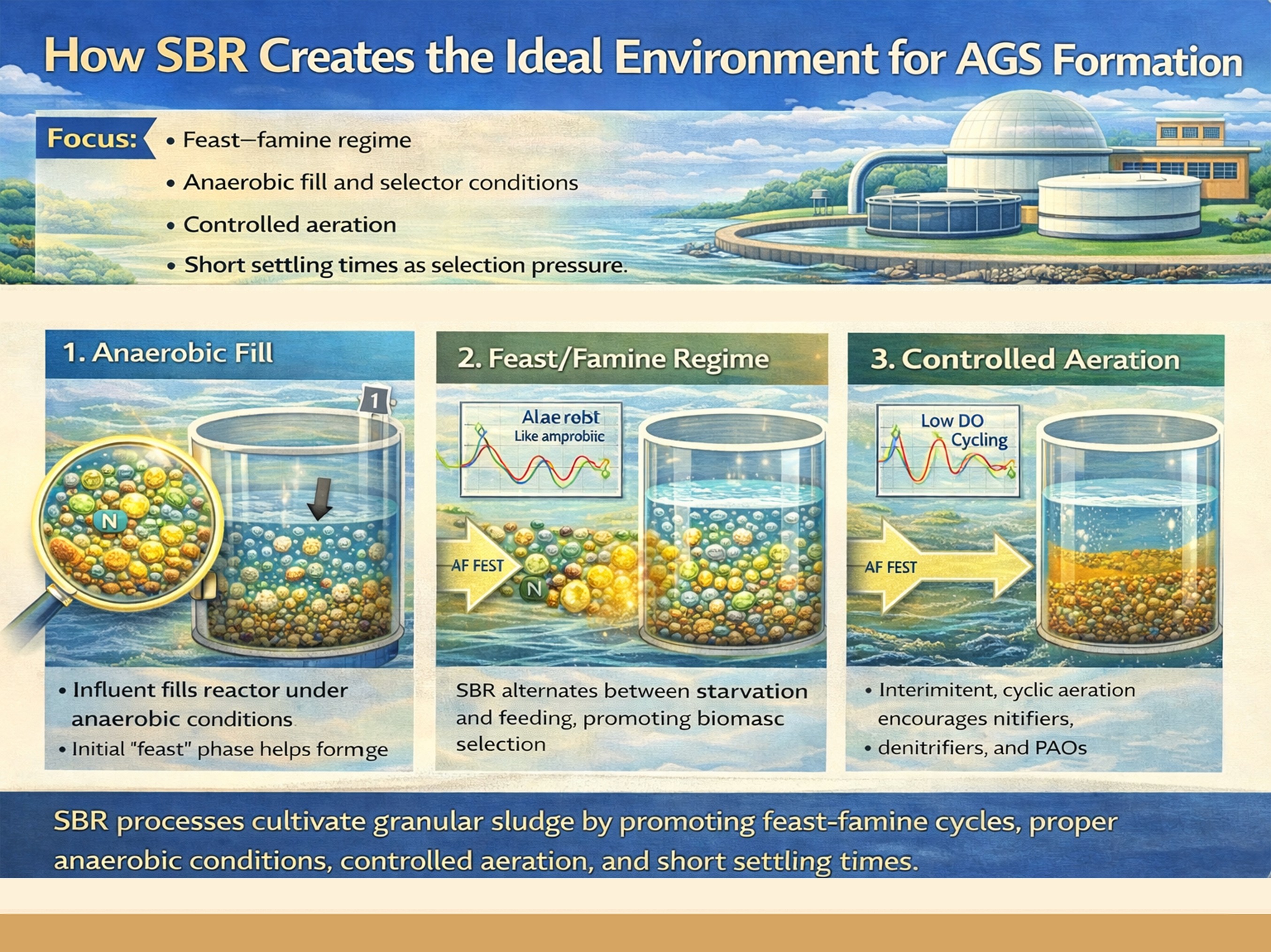
Aerobic granular sludge does not form by chance; it is the result of deliberate biological selection enabled by specific hydraulic and operational conditions. Among available treatment configurations, the sequencing batch reactor is uniquely suited to create these conditions. As established in Article 7: What Makes Aerobic Granular Sludge Different from Flocculent Sludge, granulation depends on structure, settling behaviour, and internal biological zoning—outcomes that the SBR process naturally supports.
Time as a Design Variable
Unlike continuous-flow systems, SBRs operate in defined phases—fill, react, settle, and decant. This time-based operation allows precise control over when substrates are introduced, when oxygen is supplied, and when biomass is retained or selected out. Time, rather than tank volume alone, becomes an active design tool.
This temporal control is essential for creating the feast–famine conditions that drive granule formation.
Anaerobic Fill Creates Biological Selection Pressure
During the fill phase, influent is introduced under anaerobic or low-oxygen conditions. This environment favours microorganisms capable of rapid substrate uptake and internal storage, such as phosphorus-accumulating organisms. It also supports the early stages of hydrolysis and fermentation, preparing the substrate for downstream biological reactions.
This mechanism ties directly to the influent characteristics discussed in Article 1: From Toilet to Treatment — Understanding Domestic Sewage Characteristics and the BNR pathways described in Article 4: Understanding BNR Pathways — Nitrogen and Phosphorus Removal Explained.
Feast–Famine Regimes Promote Granule Stability
SBR operation creates alternating periods of substrate abundance and scarcity. During the feast phase, microorganisms store carbon internally; during the famine phase, they rely on these reserves for growth and maintenance. This cycle discourages the growth of filamentous organisms and promotes dense, compact biomass.
Over time, these selective pressures transform flocculent sludge into stable aerobic granules.
Controlled Aeration Supports Layered Biology
Aeration in an SBR is applied only during specific phases and at controlled intensities. This prevents excessive oxygen penetration while ensuring sufficient supply for nitrification. Within granules, this results in aerobic outer layers and anoxic or anaerobic cores, enabling simultaneous nutrient removal.
This internal stratification addresses the oxygen management challenges highlighted in Article 5: Why Conventional Activated Sludge Struggles with BNR.
Short Settling Times Enforce Natural Selection
One of the most powerful selection tools in an AGS-based SBR is short settling time. Biomass that settles quickly is retained, while slow-settling flocs are washed out during decant. This simple hydraulic selection pressure replaces complex mechanical controls and encourages the dominance of granular sludge.
The result is a self-stabilising system that improves over time rather than degrading.
Reduced Reliance on External Control
Because selection is driven by cycle design rather than constant adjustment, AGS-based SBRs are less dependent on operator intervention. Once granulation is established, the system maintains itself through biological feedback mechanisms.
This robustness makes SBR–AGS systems well suited for decentralised installations and variable influent conditions.
Enabling Simultaneous Nutrient Removal
By combining anaerobic fill, controlled aeration, and internal granule stratification, the SBR process enables nitrification, denitrification, and biological phosphorus removal within a single reactor. This integration simplifies plant layout while enhancing performance.
These outcomes set the stage for evaluating the tangible benefits of AGS-based BNR.