Understanding BNR Pathways: Nitrogen and Phosphorus Removal Explained
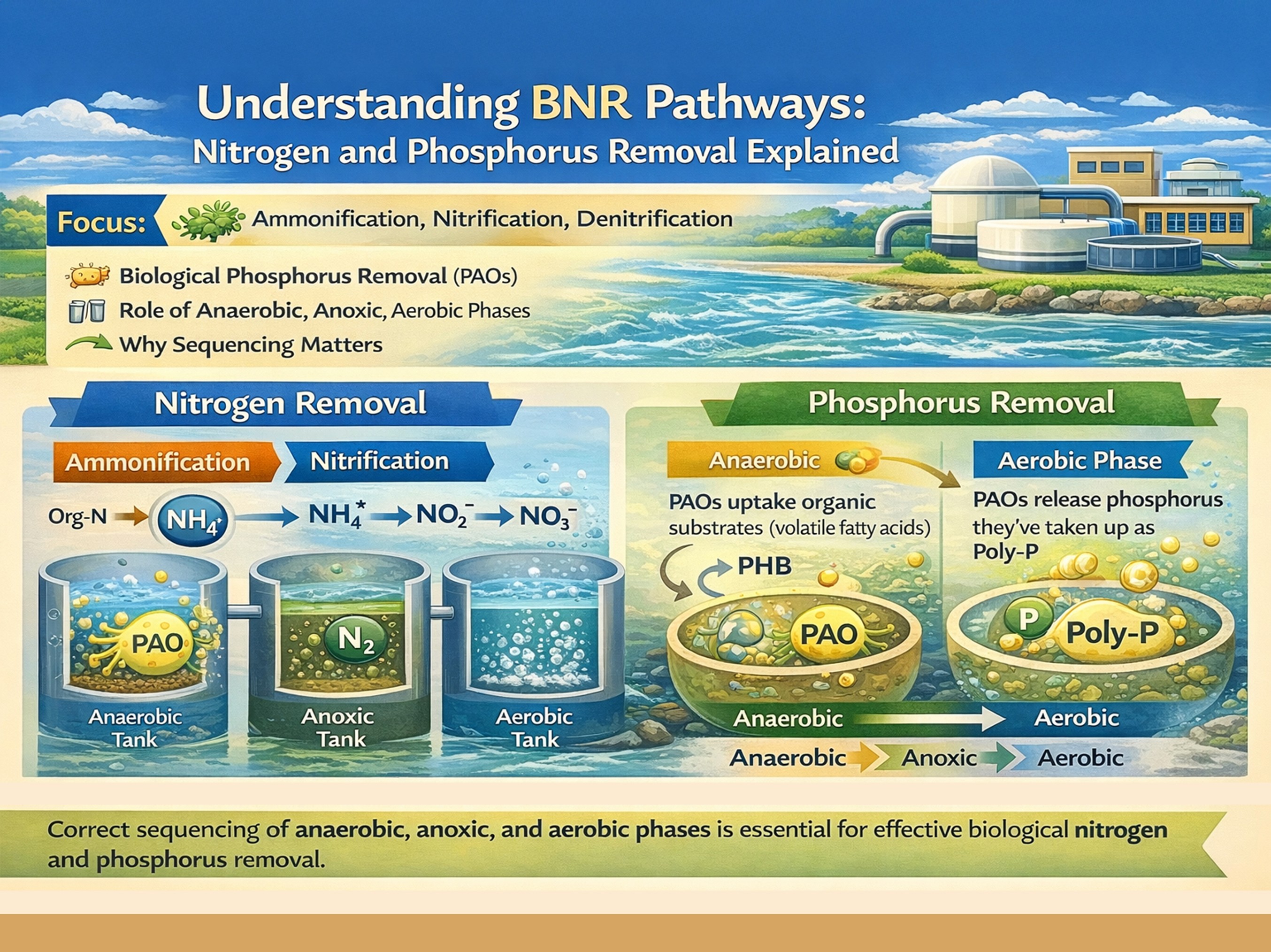
Biological Nutrient Removal is often spoken of as a single treatment objective, but in practice it is the outcome of several distinct biological pathways operating in sequence and, in some cases, simultaneously. As established in Article 3: Why Biological Nutrient Removal (BNR) Is the Need of the Hour, nutrient removal cannot be achieved through extended aeration or chemical correction alone. It requires controlled biological environments that support specific microbial reactions.
Nitrogen Removal Is a Multi-Step Biological Process
Nitrogen enters domestic sewage primarily as organic nitrogen and ammoniacal nitrogen, as described in Article 1: From Toilet to Treatment — Understanding Domestic Sewage Characteristics. Organic nitrogen must first be converted into ammonia through ammonification, a process that occurs under anaerobic or low-oxygen conditions. Ammonia is then oxidised to nitrite and further to nitrate through nitrification, an aerobic process carried out by slow-growing autotrophic bacteria.
However, nitrification alone does not remove nitrogen; it merely transforms it. True nitrogen removal occurs only when nitrate is reduced to nitrogen gas through denitrification, an anoxic process that requires readily biodegradable carbon.
The Role of Oxygen Control in Nitrogen Pathways
The success of nitrification and denitrification depends on precise oxygen management. Excess oxygen suppresses denitrification, while insufficient oxygen destabilises nitrification. This balance cannot be achieved through continuous aeration alone. It requires deliberate phase separation or micro-environment creation within the biomass.
This challenge explains why conventional systems struggle with nitrogen removal and sets the context for Article 5:
Why Conventional Activated Sludge Struggles with BNR.
Phosphorus Removal Requires Biological Cycling
Biological phosphorus removal follows a fundamentally different logic. Phosphorus-accumulating organisms (PAOs) must first experience anaerobic conditions where they release phosphorus while storing carbon internally. During subsequent aerobic phases, these organisms uptake phosphorus in excess of their metabolic needs, allowing phosphorus to be removed with waste sludge.
If anaerobic conditions are not properly established, phosphorus removal remains incomplete regardless of aeration intensity. This reinforces the need for sequencing and controlled biological exposure rather than continuous treatment.
Carbon Availability Links Nitrogen and Phosphorus Removal
Carbon plays a central role in both denitrification and biological phosphorus removal. As discussed in Article 2:
Beyond BOD — Why Modern Sewage Treatment Must Address Nutrients, readily biodegradable carbon is limited in domestic sewage. If carbon is consumed prematurely—through excessive aeration or poor upstream design—both nitrogen and phosphorus removal pathways are compromised.
This interdependence makes carbon preservation a design priority rather than an operational adjustment.
Sequencing Enables Multiple Pathways in One System
BNR succeeds when biological environments are created in the correct order and duration. Anaerobic conditions enable phosphorus release and carbon storage. Aerobic conditions support nitrification and phosphorus uptake. Anoxic conditions facilitate denitrification. These phases can occur either in separate zones or within structured biomass that naturally creates internal gradients.
Understanding how such environments are formed biologically leads directly into the evolution of alternative sludge structures, introduced in Article 6: The Evolution Toward Aerobic Granular Sludge (AGS).
Why BNR Is Sensitive to Hydraulic and Load Variability
BNR pathways are vulnerable to fluctuations in flow and organic load. Sudden changes disrupt microbial populations and phase stability, reducing nutrient removal efficiency. This sensitivity highlights the importance of upstream equalisation and controlled feeding—topics implicitly connected to earlier discussions on influent characteristics and system design.
Plants that ignore this sensitivity often rely on corrective measures rather than addressing root causes.
BNR Requires Biology That Can Do More Than One Job
Traditional biological systems were optimised for carbon removal under steady aerobic conditions. BNR demands much more: the ability to host multiple microbial populations, tolerate changing redox conditions, and respond to variable loading without losing performance.
This requirement exposes the structural limitations of floc-based systems and sets the stage for exploring alternative biological architectures.