Why Conventional Activated Sludge Struggles with BNR
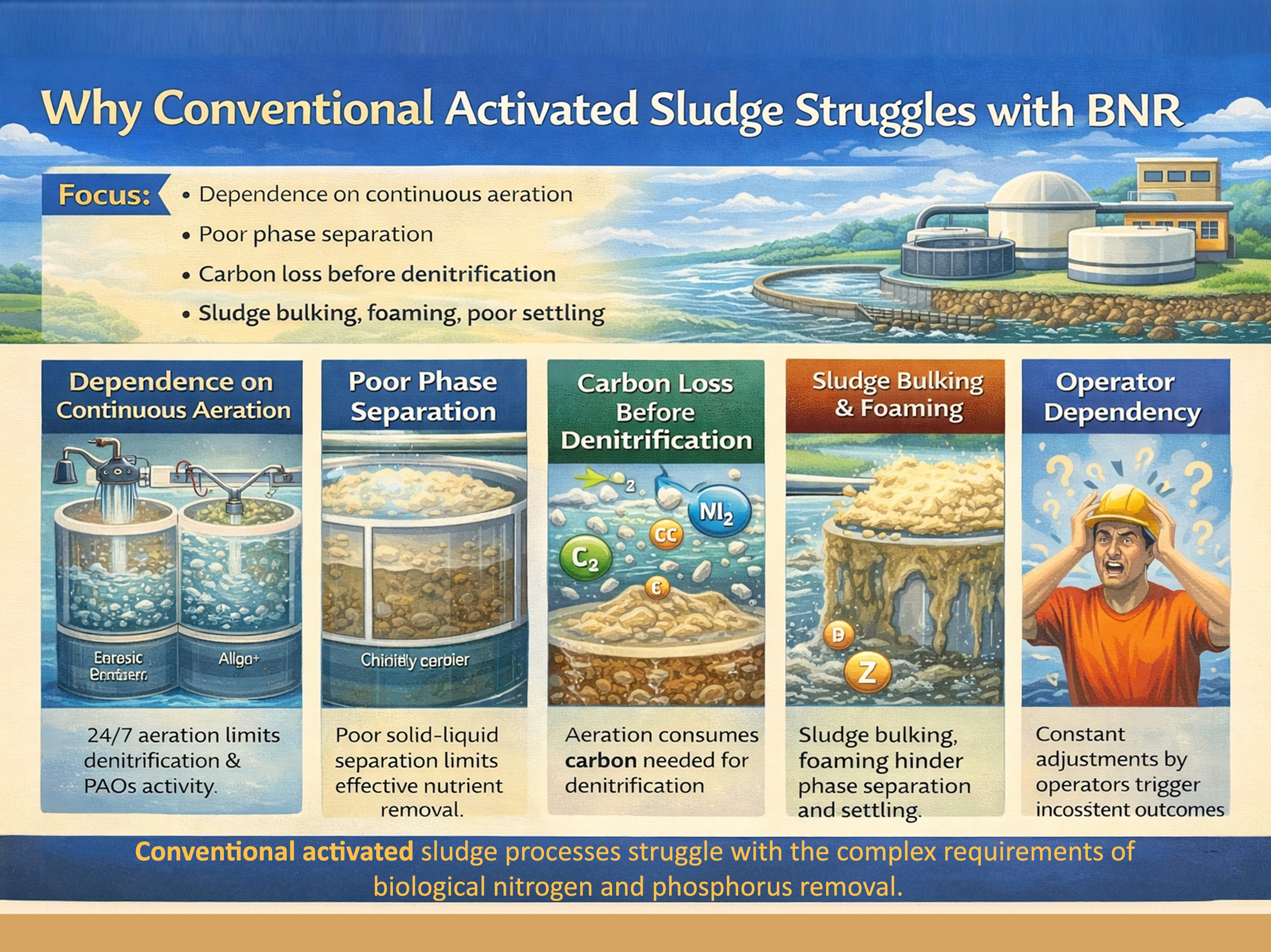
Activated Sludge SBRs combine the batch operation of sequencing with the biology of conventional activated sludge. While this configuration improves flexibility compared to continuous-flow systems, it does not overcome the fundamental biological limitations of activated sludge when tasked with Biological Nutrient Removal. As explained in Article 4: Understanding BNR Pathways — Nitrogen and Phosphorus Removal Explained, nutrient removal requires precise control of anaerobic, anoxic, and aerobic environments—conditions that Activated Sludge SBRs struggle to sustain reliably.
Continuous Exposure to Oxygen Limits Sequencing Benefits
Although SBRs operate in phases, Activated Sludge SBRs often maintain aerobic conditions for most of the cycle to protect nitrification and prevent biomass deterioration. This continuous or near-continuous oxygen exposure suppresses denitrification and biological phosphorus release, forcing designers to rely on operational compromises rather than biological optimisation.
Carbon Is Consumed Before It Can Be Utilised for BNR
In Activated Sludge SBRs, incoming carbon is rapidly oxidised during aeration phases. As discussed in Article 2:
Beyond BOD — Why Modern Sewage Treatment Must Address Nutrients,
readily biodegradable carbon is limited and valuable. Its premature consumption leaves insufficient substrate for denitrification and biological phosphorus removal, resulting in partial BNR or dependence on external carbon dosing.
Biomass Structure Limits Internal Zoning
Activated sludge exists as loosely aggregated flocs that are fully exposed to bulk liquid conditions. This structure prevents the formation of stable internal anaerobic or anoxic zones within the biomass. As a result, Activated Sludge SBRs must rely on time-based phase separation alone, which becomes increasingly fragile under variable loading.
This limitation contrasts with the granular structure introduced later in Article 6: The Evolution Toward Aerobic Granular Sludge (AGS).
Settling Constraints Drive Conservative Design
Activated Sludge SBRs are sensitive to settling performance. Sludge bulking, poor compaction, and washout risks force designers to adopt longer settling times and lower loading rates. These conservative choices increase reactor volume and reduce process intensity, directly impacting footprint and efficiency.
High Operator Dependency Persists
Despite batch operation, Activated Sludge SBRs remain operator-intensive. Aeration timing, sludge wasting, and cycle adjustments require continuous oversight. Small deviations can quickly destabilise nutrient removal performance, especially under fluctuating influent conditions.
Structural Mismatch with BNR Objectives
The recurring challenges—carbon loss, lack of internal zoning, settling instability, and operator dependency—point to a structural mismatch. Activated Sludge SBRs were optimised for carbon removal, not for integrated nutrient control.
Recognising this limitation explains why alternative biological structures gained attention.