Beyond BOD: Why Modern Sewage Treatment Must Address Nutrients
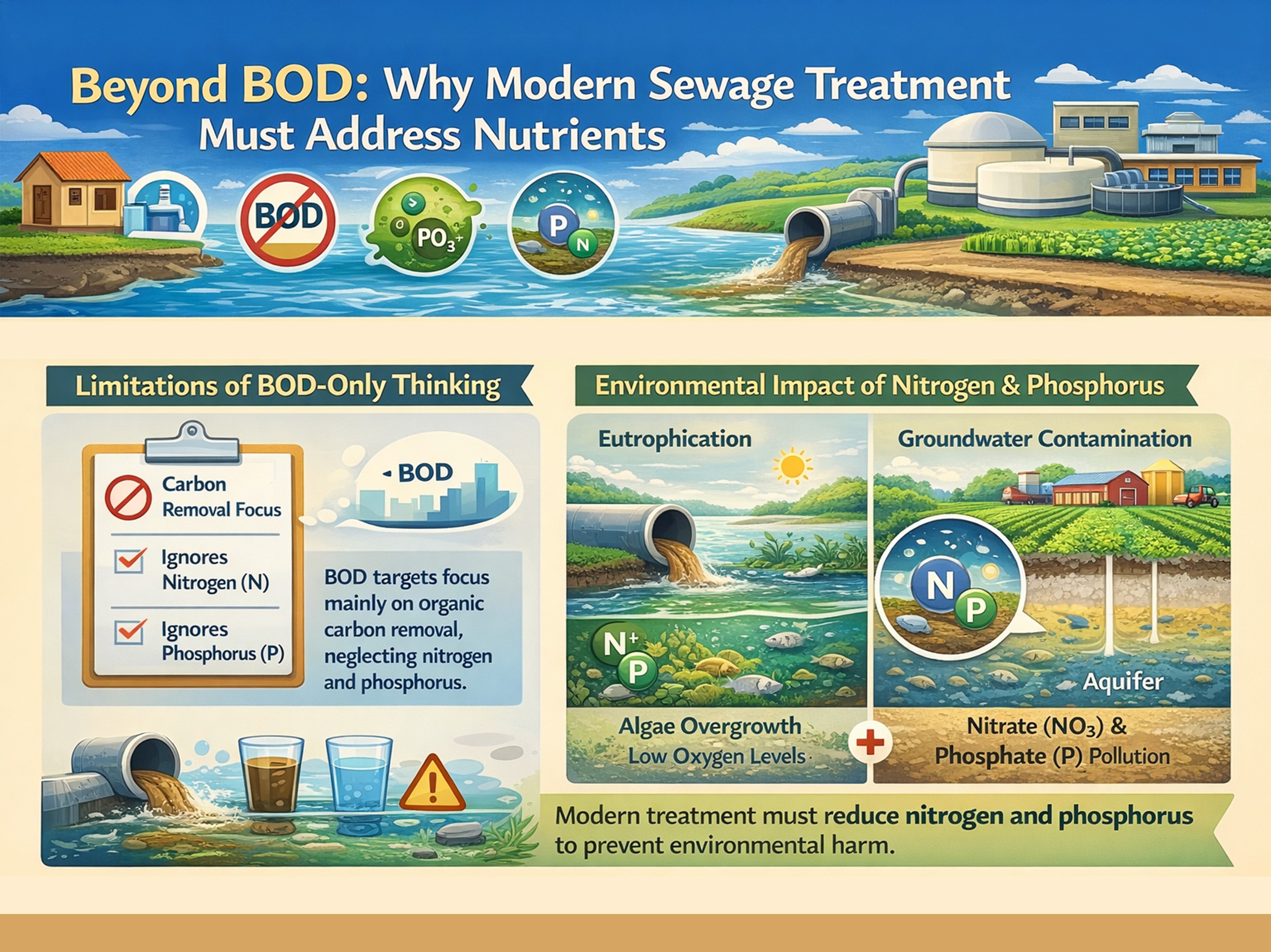
For many years, sewage treatment success was equated with BOD reduction. While this metric remains relevant, it no longer captures the full environmental impact of treated effluent. As established in Article 1:
From Toilet to Treatment — Understanding Domestic Sewage Characteristics,
domestic sewage carries nutrients alongside organic carbon. Treating only carbon leaves critical pollutants unaddressed.
BOD Reduction Does Not Guarantee Environmental Safety
BOD reflects the oxygen demand exerted by organic matter but does not account for nitrogen or phosphorus behaviour after discharge. Effluent can meet BOD norms and still drive eutrophication, algal blooms, and groundwater contamination. This disconnect explains why many compliant plants continue to face environmental scrutiny.
The persistence of nutrients becomes clearer when their biological pathways are examined in Article 4:
Understanding BNR Pathways — Nitrogen and Phosphorus Removal Explained.
Nutrients Accumulate While Carbon Disappears
Carbon is rapidly oxidised in conventional treatment systems, while nitrogen and phosphorus remain biologically active. Nitrification without denitrification simply converts ammonia to nitrate, and phosphorus remains unless specific biological cycling is introduced.
This imbalance highlights why nutrient control cannot be treated as an extension of carbon removal, a theme expanded in Article 3:
Why Biological Nutrient Removal (BNR) Is the Need of the Hour.
Changing Environmental and Regulatory Expectations
Reduced dilution capacity, increased water reuse, and ecological degradation have shifted regulatory focus toward long-term environmental protection. While not all standards explicitly state nutrient limits, the direction is clear: treatment must protect receiving environments, not merely meet short-term metrics.
This shift sets the context for the broader discussion on BNR and its practical necessity.
Chemical Correction Is Not a Sustainable Solution
Chemical dosing can suppress nutrient concentrations temporarily, but it introduces operational complexity, recurring costs, and long-term dependency. Biological nutrient removal offers a more stable and sustainable alternative, provided the system is designed to support it.
The structural challenges of achieving this in conventional systems are discussed in Article 5:
Why Conventional Activated Sludge Struggles with BNR.
Beyond BOD Is a Design Mindset Shift
Moving beyond BOD is not about adding processes but about redefining treatment objectives. When nutrient removal becomes central, decisions around equalisation, aeration, and biological selection change fundamentally.
This mindset shift leads naturally into the question of how nutrient removal can be reliably achieved.
Setting the Case for BNR
Once the limitations of BOD-centric treatment are understood, Biological Nutrient Removal emerges as a necessary response rather than an optional upgrade. BNR aligns treatment goals with influent reality and environmental protection.
The rationale and urgency for this transition are examined in detail in the next article.