From Toilet to Treatment: Understanding Domestic Sewage Characteristics
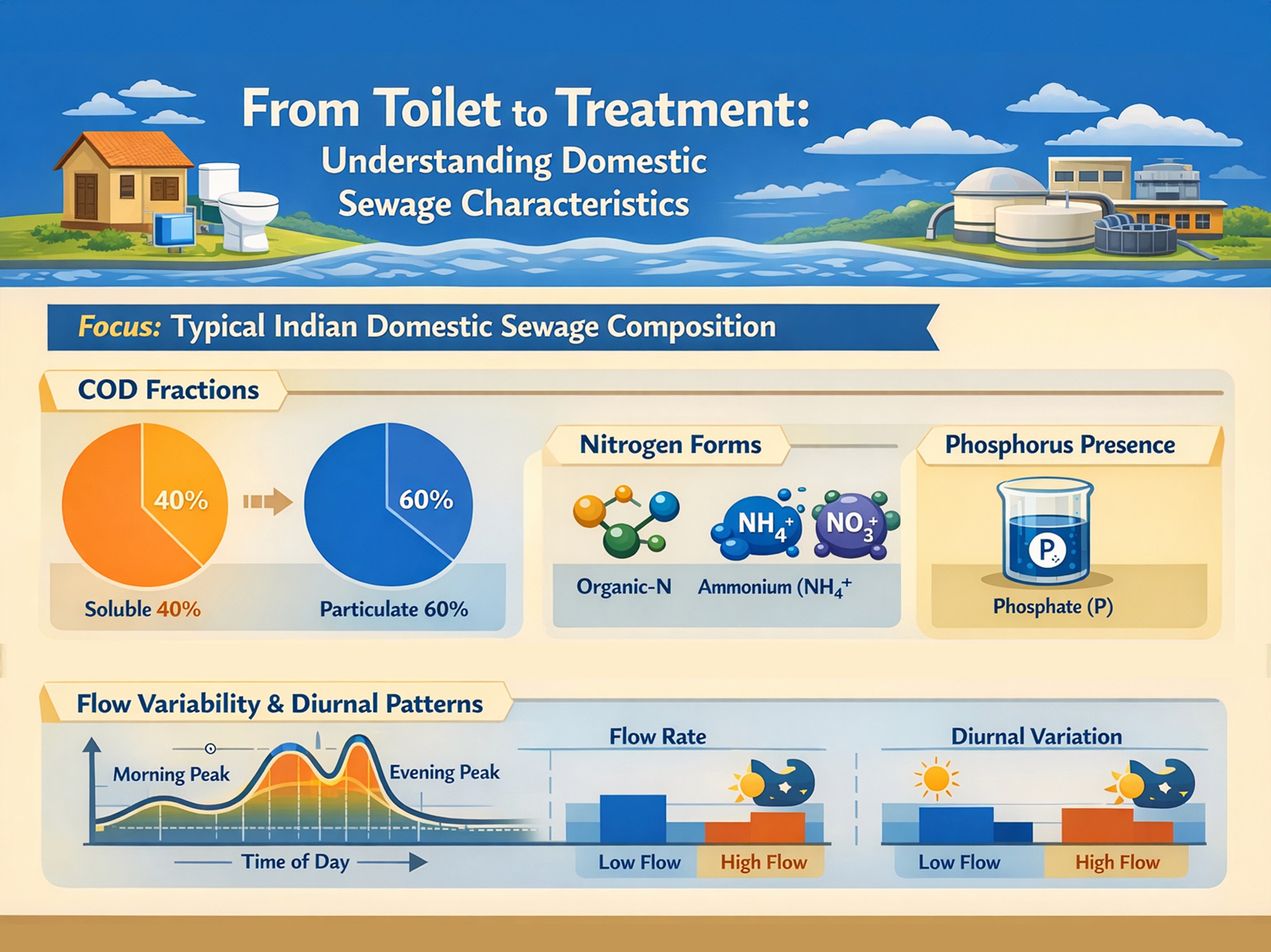
Sewage treatment begins long before wastewater enters a reactor. It begins with understanding what domestic sewage actually contains and how it behaves. Modern treatment challenges—nutrient removal, process instability, and rising compliance expectations—can all be traced back to influent characteristics that are often oversimplified or misunderstood. As this series will demonstrate, successful Biological Nutrient Removal depends on respecting these characteristics from the outset.
Domestic Sewage Is Inherently Variable
Domestic sewage reflects human activity rather than industrial consistency. Flow and load fluctuate sharply over the day, with concentrated peaks in the morning and evening and extended low-flow periods in between. These variations are not incidental; they are intrinsic to domestic wastewater. Treatment systems that assume steady inflow are forced into corrective operation, often with limited success.
This variability becomes particularly critical when nutrient removal is required, a point that will be explored further in Article 3: Why Biological Nutrient Removal (BNR) Is the Need of the Hour.
Organic Matter Is More Than BOD
While BOD remains a commonly used indicator, it represents only a portion of the organic matter present in sewage. A large fraction enters the plant as suspended and slowly biodegradable material—food residues, faecal solids, and organic fibres. These components are not immediately available to microorganisms and must first undergo hydrolysis.
The importance of this biological conversion step becomes clearer when nutrient removal pathways are examined in Article 4:
Understanding BNR Pathways — Nitrogen and Phosphorus Removal Explained.
Carbon Exists in Competing Forms
Not all carbon in sewage serves the same biological purpose. Readily biodegradable carbon is essential for denitrification and biological phosphorus removal, yet it is present in limited quantities. Poor upstream decisions—such as excessive aeration or insufficient retention time—can consume this carbon before it reaches the zones where it is most needed.
This carbon imbalance is one of the reasons why many plants struggle with nutrient removal, despite meeting traditional BOD targets, as discussed in Article 2:
Beyond BOD — Why Modern Sewage Treatment Must Address Nutrients.
Nitrogen Is Present from the Start
Nitrogen enters domestic sewage primarily as organic nitrogen and ammonia. While its impact may not be immediately visible, untreated or partially treated nitrogen persists in the environment as nitrate, contributing to eutrophication and groundwater contamination. Addressing nitrogen requires deliberate biological sequencing rather than extended aeration.
The necessity of this approach forms the foundation of Article 3, where BNR is positioned as a response to influent reality rather than regulatory pressure alone.
Phosphorus Is Small in Quantity but Large in Impact
Although phosphorus concentrations are relatively low, their environmental consequences are significant. Without specific biological conditions, phosphorus passes through treatment systems largely unaffected. This reinforces the need for treatment processes that can support multiple biological environments within a single system.
The mechanisms that enable this will be examined later in Article 7:
What Makes Aerobic Granular Sludge Different from Flocculent Sludge.
Sewage Requires Preparation, Not Immediate Oxidation
The combined presence of variable flow, particulate organics, and embedded nutrients makes one thing clear: domestic sewage benefits from biological preparation before aggressive treatment. Time, controlled exposure, and carbon preservation are essential for downstream success.
Systems that ignore this preparation phase often rely on operational correction rather than biological stability—a recurring theme in Article 5:
Why Conventional Activated Sludge Struggles with BNR.
Setting the Biological Context
Understanding domestic sewage characteristics is not an academic exercise; it is the biological context within which all treatment decisions operate. Influent behaviour explains why nutrient removal is necessary, why conventional systems struggle, and why alternative biological structures have emerged.
These themes will be developed progressively throughout the series, beginning with a closer look at why BOD alone is no longer sufficient.