AGS-Based SBRs: A Practical Path to Compliant, Low-Risk STPs
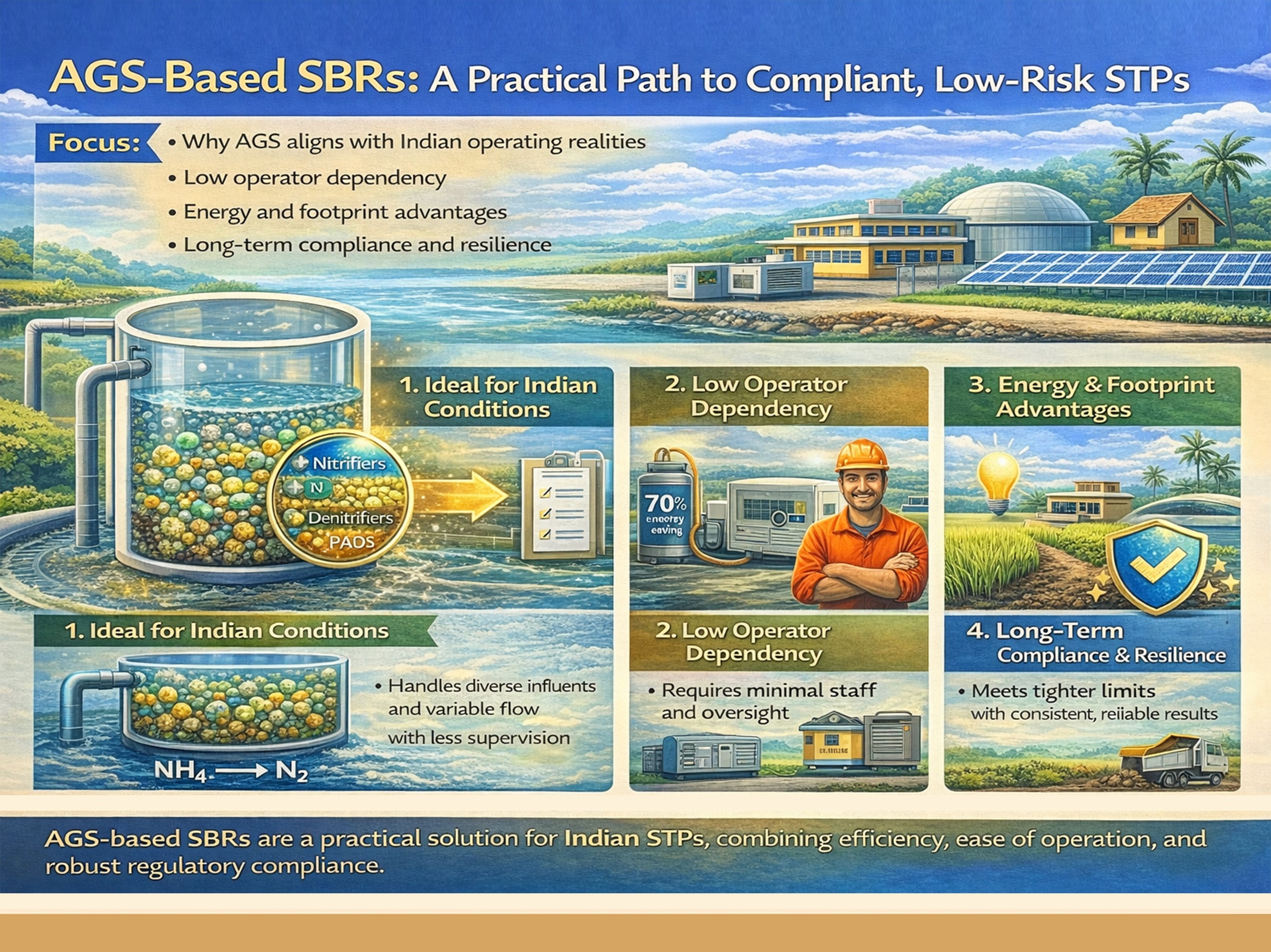
As sewage treatment objectives expand beyond carbon removal to include consistent nutrient control, the gap between theoretical capability and practical performance becomes increasingly important. Throughout this series—from influent characteristics in Article 1 to biological outcomes in Article 9—a consistent theme has emerged: systems that rely on structural biology rather than operational correction are better suited to meet modern treatment demands. AGS-based sequencing batch reactors represent this shift in practice.
Aligning Biology with Regulatory Reality
Regulatory expectations are evolving toward long-term environmental protection, reuse suitability, and nutrient control. As discussed in Article 3: Why Biological Nutrient Removal (BNR) Is the Need of the Hour, compliance today is judged not only by numerical limits but by consistency and resilience. AGS-based SBRs inherently support nitrification, denitrification, and biological phosphorus removal, aligning biological capability with regulatory intent rather than relying on downstream fixes.
Designed for Real-World Influent Variability
Domestic sewage is inherently variable in flow and composition, a reality established in Article 1: From Toilet to Treatment — Understanding Domestic Sewage Characteristics. AGS-based systems absorb this variability through robust biomass structure and rapid settling, reducing sensitivity to shock loads. This makes them particularly suitable for decentralised installations, mixed-use developments, and sites with pronounced diurnal patterns.
Reduced Operator Dependency and Process Risk
One of the most significant practical advantages of AGS-based SBRs is reduced reliance on continuous operator intervention. Biological selection, sequencing, and internal zoning replace many manual controls required in conventional systems. This contrasts sharply with the operator-intensive nature of traditional activated sludge plants described in Article 5: Why Conventional Activated Sludge Struggles with BNR.
Lower operator dependency translates directly into lower process risk and more predictable compliance.
Energy and Footprint Efficiency
By consolidating multiple biological functions into a single reactor, AGS-based SBRs achieve lower footprint and reduced mechanical complexity. Controlled, phase-specific aeration improves energy efficiency without compromising treatment performance. These efficiencies address both capital and operational constraints common in urban and semi-urban installations.
Carbon Is Used Where It Matters Most
AGS-based BNR systems preserve and reuse carbon internally, reducing or eliminating the need for external carbon dosing. As explained in Article 2: Beyond BOD — Why Modern Sewage Treatment Must Address Nutrients, carbon is a limited and valuable resource in sewage treatment. Using it efficiently improves nutrient removal while lowering chemical dependence.
Long-Term Stability Over Short-Term Optimisation
Many treatment systems perform well under ideal conditions but degrade over time as influent variability, operator changes, and equipment ageing take their toll. AGS-based SBRs prioritise long-term biological stability over short-term optimisation. This design philosophy reduces lifecycle cost and ensures sustained performance beyond initial commissioning.
A Practical Evolution, Not a Radical Departure
Importantly, AGS-based SBRs do not represent an untested or radical departure from biological treatment principles. They are an evolution—building on well-understood biological pathways described in Article 4: Understanding BNR Pathways — Nitrogen and Phosphorus Removal Explained and refining how those pathways are enabled structurally and operationally.
From Compliance to Confidence
By embedding nutrient removal capability into the core biological structure, AGS-based SBRs move sewage treatment from reactive compliance to confident performance. Plants designed this way are better equipped to meet future regulatory tightening without structural modification or escalating operational complexity.
Modern sewage treatment demands systems that are biologically capable, operationally resilient, and regulator-ready. AGS-based SBRs meet these requirements by aligning influent reality, biological behaviour, and regulatory intent into a single, coherent design philosophy.
Rather than compensating for limitations, they remove them.