Why Sewage Treatment Plants Fail When Designed Only on BOD
Understanding the hidden design gaps behind “compliant” but unstable STPs
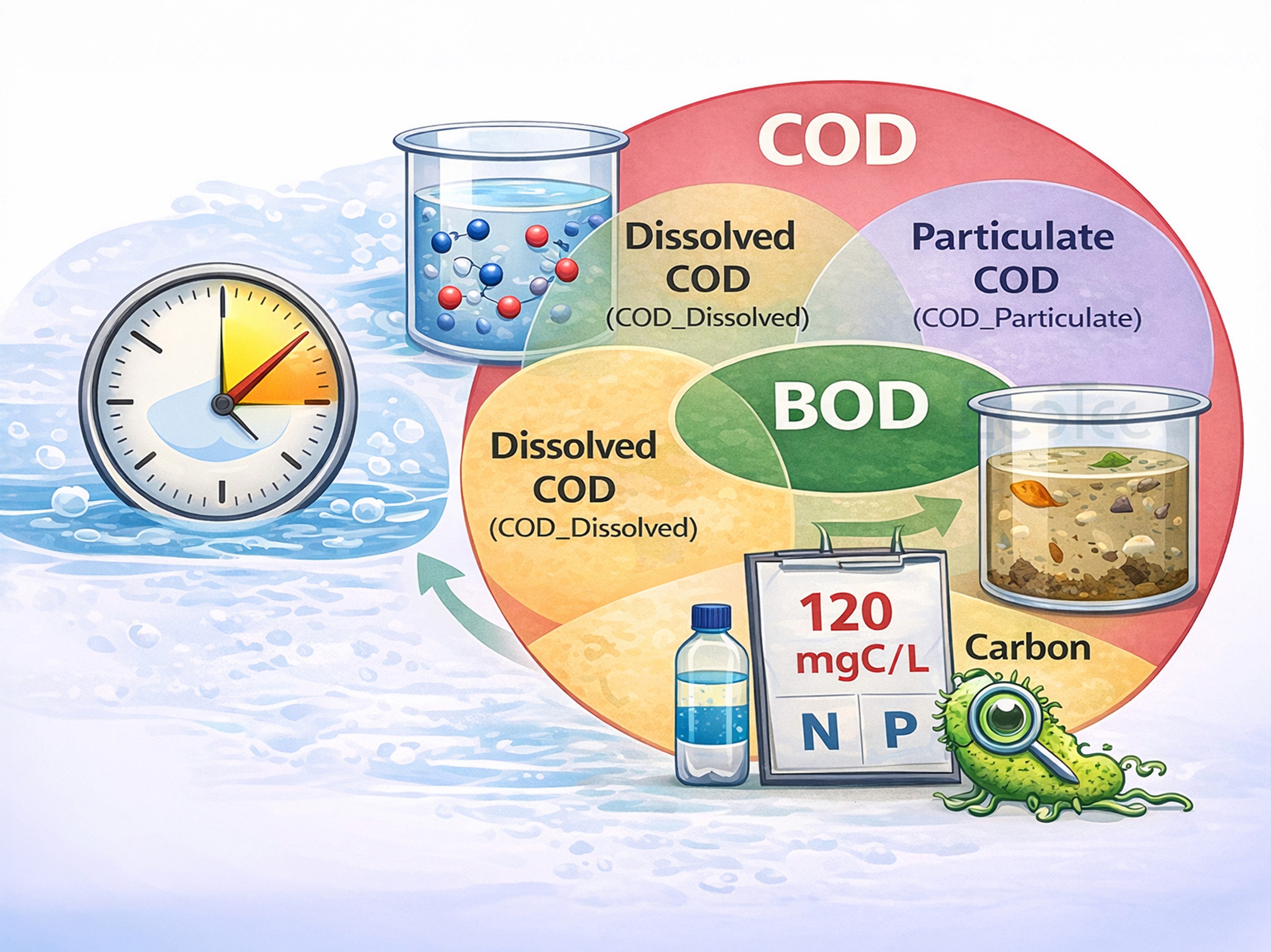
When Compliance Does Not Mean Performance
Across India, many sewage treatment plants (STPs) technically comply with discharge norms prescribed by the Central Pollution Control Board (CPCB). Treated water reports show BOD values within limits, and yet these plants continue to face:
High and rising energy consumption
Persistent COD in the treated water
Poor or inconsistent nitrogen removal
Sludge handling and settling issues
Gradual decline in long-term performance
This raises a critical design question: Why do STPs fail operationally even when they meet BOD limits?
The answer lies not in operation alone, but in how the plant was designed in the first place.
The Fundamental Design Assumption Behind BOD-Based STPs
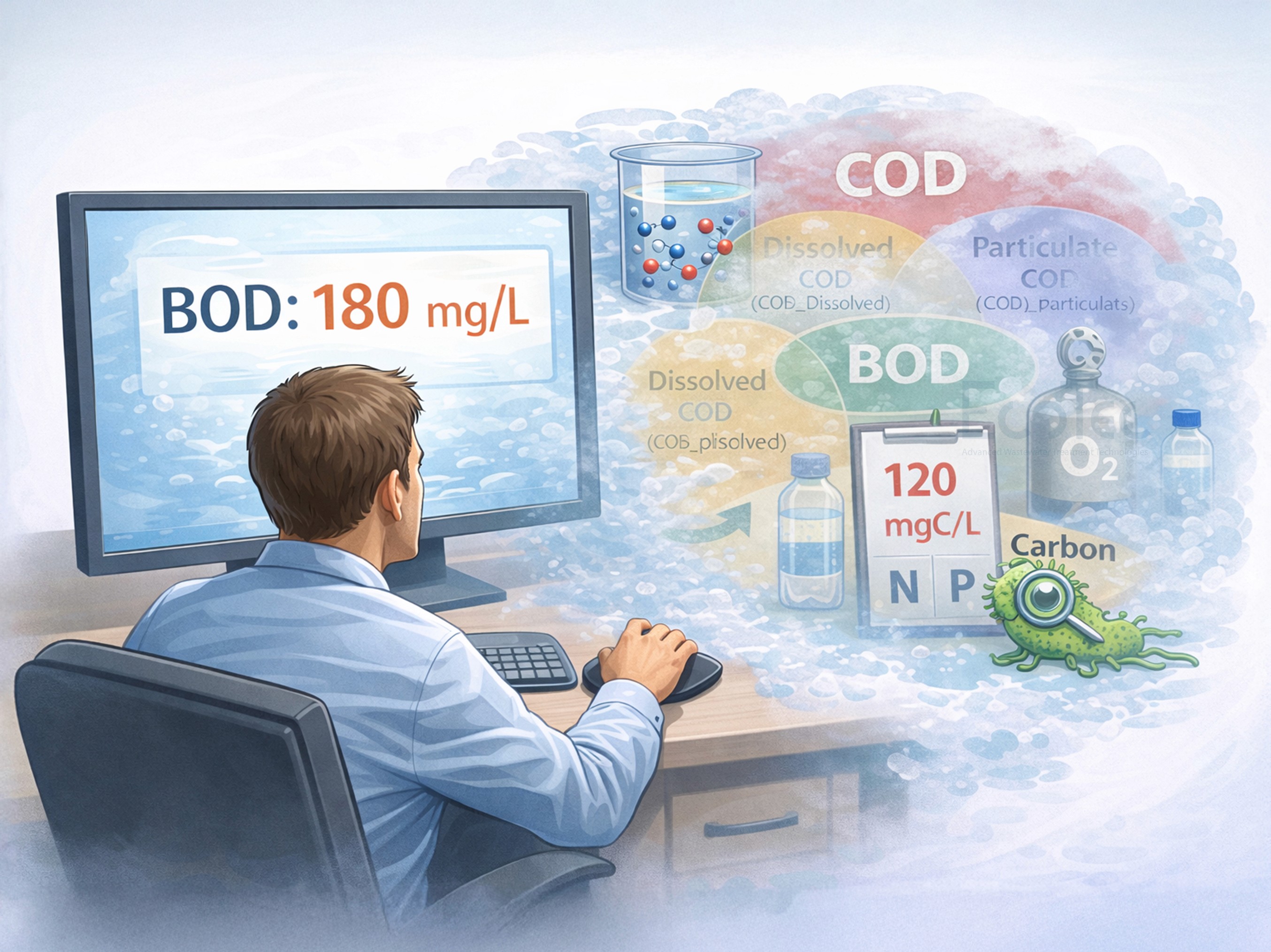
When an STP is designed primarily on BOD, it implicitly assumes that:
Oxygen demand is uniform and predictable
Biological reactions occur steadily over time
Meeting BOD automatically ensures overall treatment success
These assumptions were acceptable when:
Effluent expectations were limited to basic pollution control
Nutrient removal was not a priority
Energy efficiency was secondary
Today, these assumptions no longer hold.
Failure Mode 1: BOD Ignores a Large Portion of Organic Load
BOD measures only the oxygen demand of easily biodegradable organics over a fixed test period. It does not account for:
Slowly biodegradable particulate organics
Inert organic matter that cannot be biologically removed
As a result:
An STP may show low BOD
While significant COD remains untreated
This leads to:
Apparent compliance
Actual underperformance
👉 To understand what BOD misses, read:
Failure Mode 2: Oxygen Is Supplied When Biology Cannot Use It
In many BOD-designed STPs:
Aeration duration is fixed
Oxygen is supplied continuously or for long periods
However, biological reactions do not occur continuously:
Some COD reacts immediately
Some reacts only after hydrolysis
Some never reacts at all
When aeration is applied outside these reaction windows:
Oxygen remains unused
Energy is consumed without treatment benefit
Performance plateaus despite longer aeration
This creates the illusion of “under-treatment,” when the real issue is reaction timing mismatch.
👉 This concept is explored in:
Failure Mode 3: Nutrient Removal Fails Despite Good BOD
Modern STPs are increasingly expected to control nitrogen. However, biological nitrogen removal requires:
Adequate biodegradable carbon
Carbon availability at the correct time
Alternating aerobic and anoxic conditions
BOD-based design does not ensure:
Sufficient carbon for denitrification
Proper timing of carbon availability
As a result:
Ammonia may be removed
Total nitrogen often remains high
This failure is often misattributed to operation, while the root cause lies in carbon availability not considered during design.
Failure Mode 4: Sludge Problems Accumulate Over Time
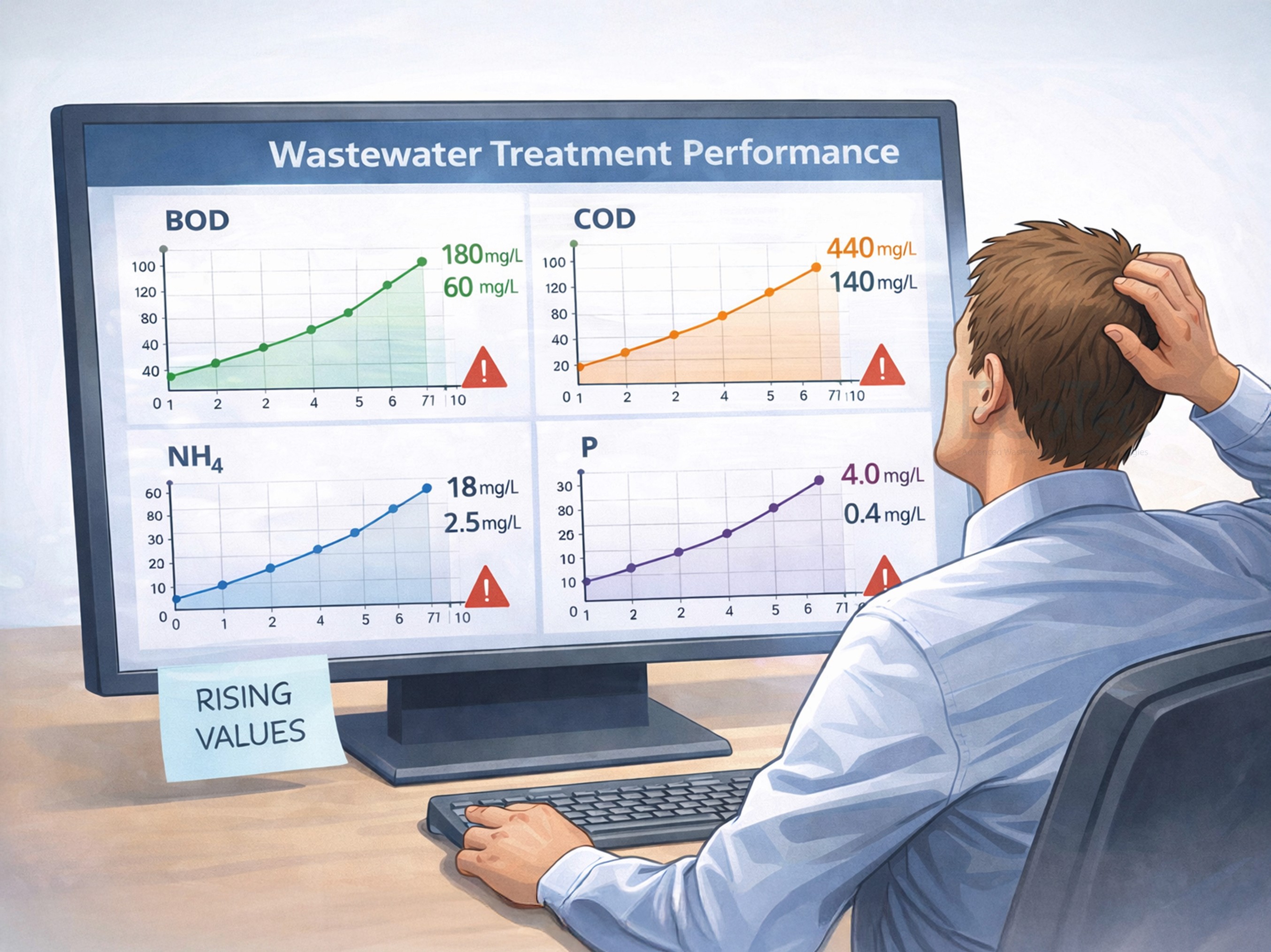
Because BOD-based design does not explicitly consider:
Inert COD
Slowly biodegradable solids
These fractions tend to:
Accumulate in the system
Increase sludge volume
Affect settleability and stability
Over time, the STP becomes harder to operate, even though original design criteria were “met.”
Why These Failures Appear Gradually
One of the most misleading aspects of BOD-based design is that failure is rarely immediate.
Typically:
Initial performance appears acceptable
Problems emerge months or years later
Energy use increases first
Treatment stability declines next
This gradual degradation often shifts blame to:
Operators
Maintenance
Equipment
While the real cause is a design framework that never accounted for full organic behaviour.
Why Regulations Have Also Moved Beyond BOD
The increasing regulatory emphasis on COD and nutrients reflects these realities.
Regulatory bodies recognised that:
BOD-compliant plants still polluted receiving waters
Nutrients continued to drive eutrophication
Energy-intensive plants were unsustainable
👉 This shift is explained in:
What a Better Design Approach Requires
To avoid these failures modes, STP design must consider:
COD behaviour, not just BOD values
Reaction timing, not just aeration hours
Hydrolysis and equalisation as core processes
Biology as the treatment mechanism, aeration as the enabler
This shift does not make systems complex - it makes them Predictable.
What to Read Next
Conclusion
BOD-based design helped the industry reach a baseline level of compliance. However, modern STP challenges demand more than baseline thinking.
Plants fail not because they lack air or equipment, but because they were designed without understanding how sewage actually behaves.
Moving beyond BOD is not about changing regulations — it is about changing design logic.