COD Decoding: Understanding What Is Really in Sewage
Why COD is not just a number—and why decoding it changes how STPs should be designed
Why COD Needs to Be “Decoded”
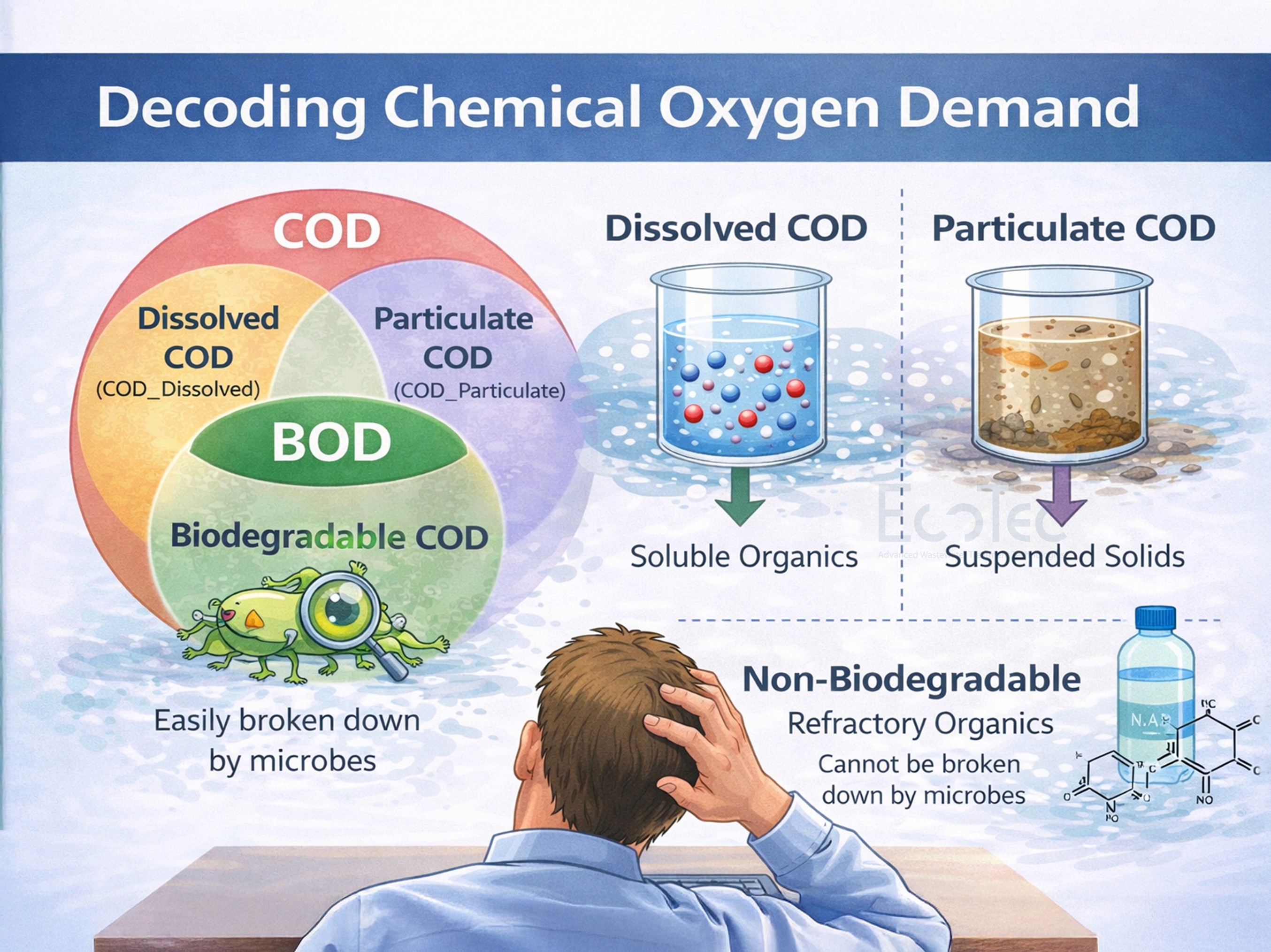
In many sewage treatment plant (STP) designs, Chemical Oxygen Demand (COD) is treated as a single value—reported, checked, and sometimes compared against limits prescribed by the Central Pollution Control Board (CPCB).
Yet in practice, engineers and operators often observe that:
COD remains high even when BOD is low
Longer aeration does not reduce COD further
Nitrogen removal is inconsistent despite “adequate” treatment
These observations point to a simple but often ignored reality:
COD is not a single type of organic matter.
It is a mixture of very different fractions, each behaving differently in biology.
Understanding COD therefore requires decoding it.
What COD Actually Represents
COD measures the total oxygen demand of organic matter in wastewater—both biodegradable and non-biodegradable—using a chemical test.
Unlike BOD, COD:
Captures fast and slow reacting organics
Includes particulate and soluble matter
Includes organics that biology can never remove
COD therefore gives a more complete picture of what is present in sewage.
But by itself, a total COD number still does not explain how treatment will behave.
COD Is a Combination of Different Fractions
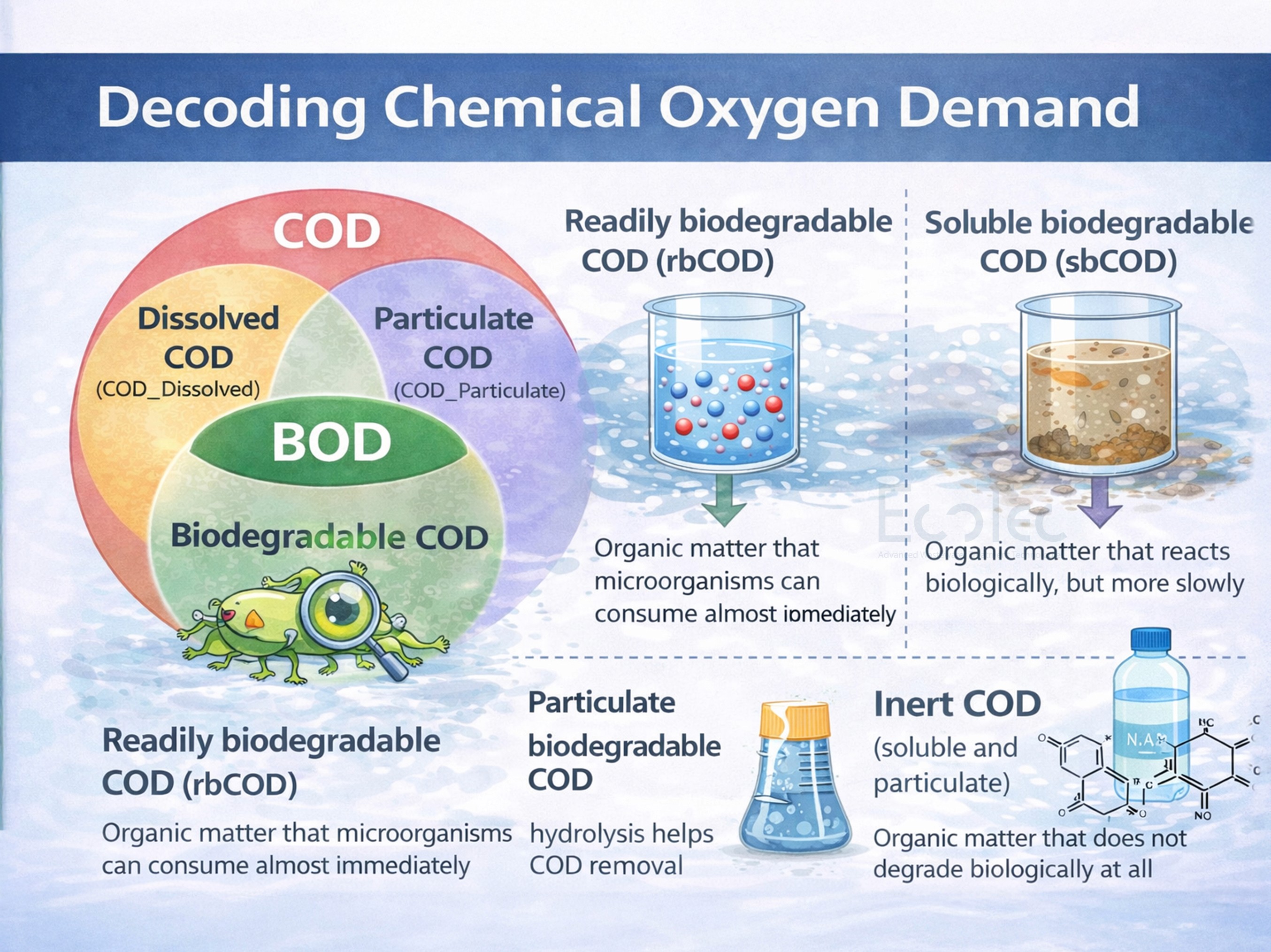
To be meaningful for design, COD must be viewed as a set of fractions, not a single value.
Broadly, COD consists of:
Readily biodegradable COD (rbCOD)
Organic matter that microorganisms can consume almost immediately.
Soluble biodegradable COD (sbCOD)
Organic matter that reacts biologically, but more slowly.
Particulate biodegradable COD
Organic matter must first undergo hydrolysis before it can be used by biology.
Inert COD (soluble and particulate)
Organic matter that does not degrade biologically at all.
Each of these fractions:
Exerts oxygen demand at a different time
Contributes differently to treatment performance
Responds differently to aeration and retention time
Today, these assumptions no longer hold.
Why Total COD Alone Is Misleading
Two wastewaters can have the same COD value and still behave very differently inside an STP.
For example:
One may be rich in rbCOD and react quickly
Another may be dominated by particulate or inert COD and react slowly—or not at all
If design is based only on total COD:
Aeration may be applied too early or too late
Biological reactions may be incomplete
Energy may be consumed without proportional treatment benefit
This is why COD decoding is more important than COD measurement alone.
The Role of Hydrolysis in COD Behaviour
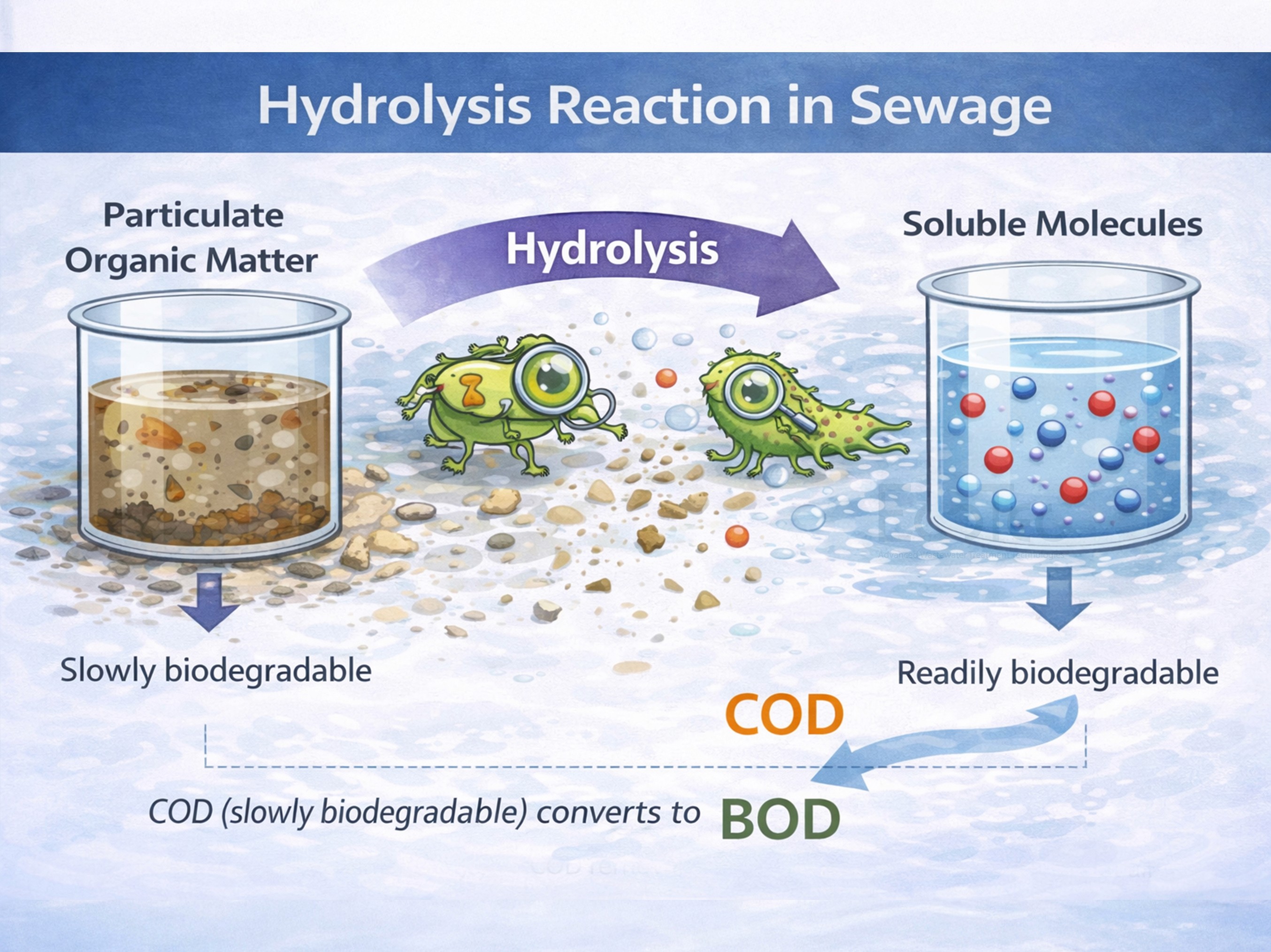
A large fraction of sewage COD is particulate.
Before biology can oxidise it, this particulate COD must be converted into soluble form through hydrolysis.
Hydrolysis:
Is a biological, enzyme-driven process
Takes time
Cannot be accelerated by increasing aeration
If hydrolysis has not occurred:
Oxygen remains unused
COD removal plateaus
Extended aeration shows little benefit
This explains why some STPs appear “under-treated” even with long aeration durations.
👉 This links directly to:
Inert COD: The Invisible Limitation
Inert COD is often the most misunderstood fraction.
Key Characteristics:
It does not degrade biologically
It passes through biological reactors unchanged
It accumulates in sludge over time
No amount of:
Aeration
Retention time
Biological optimisation
can remove inert COD.
Designs that assume all COD is removable inevitably:
Overestimate achievable performance
Create unrealistic expectations
Lead to long-term operational stress
Recognising inert COD is essential for realistic design and compliance planning.
Why COD Decoding Matters for Nutrient Removal
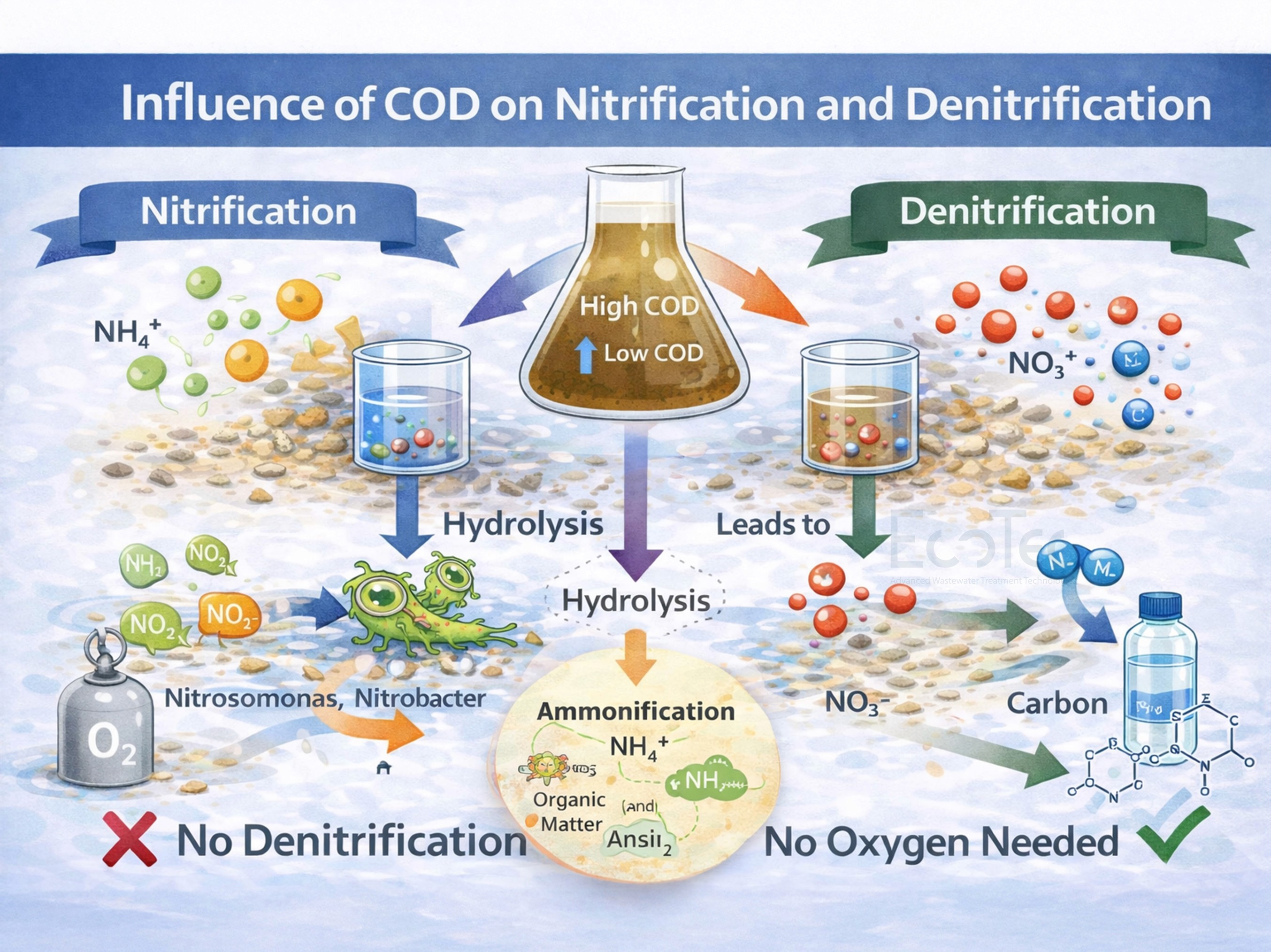
Biological nitrogen removal depends on:
Availability of biodegradable carbon
Carbon being available at the right time
Total COD does not indicate whether:
Sufficient rbCOD is present for denitrification
Carbon will be available during anoxic phases
This is why many STPs:
Achieve ammonia removal
But struggle with total nitrogen
COD decoding helps identify whether the right type of carbon exists to support nutrient removal—without relying on trial-and-error operation.
How COD Decoding Improves Design Decisions
When COD is decoded at the design stage, engineers can:
Align aeration with actual oxygen demand
Design for reaction timing, not averages
Set realistic expectations for COD and nutrient removal
Avoid over-sizing blowers and reactors
Improve long-term stability and energy efficiency
In short, COD decoding transforms STP design from assumption-based to behaviour-based.