Reaction Timing vs Aeration Duration: Why Time Alone Is Misleading
Understanding why longer aeration does not always lead to better treatment
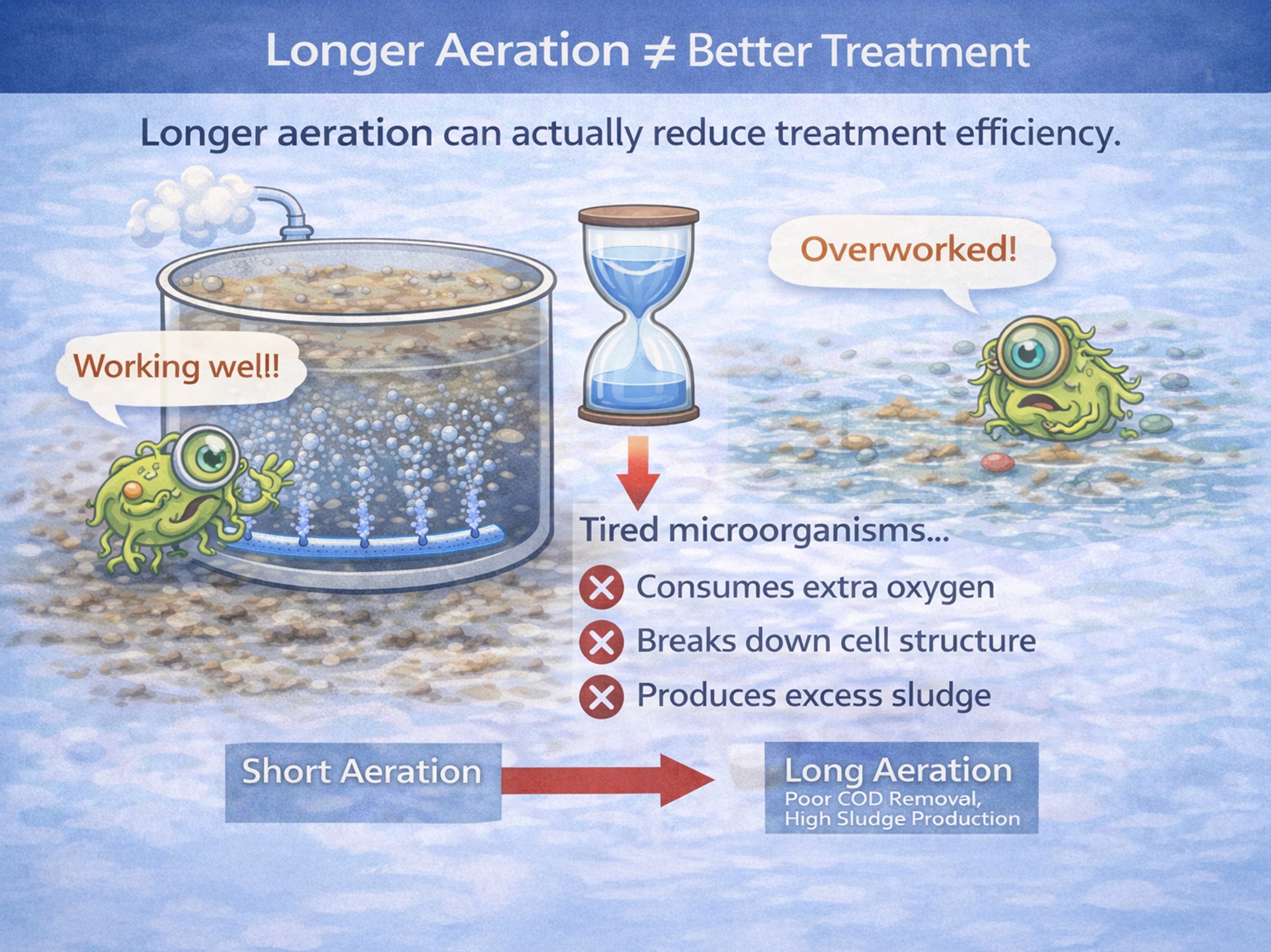
When More Time Does Not Mean More Treatment
In many sewage treatment plants (STPs), aeration adequacy is judged by duration:
Number of aeration hours per day
Length of blower operation
Fixed aeration cycles
When performance drops, the common response is to increase aeration time.
Yet many STPs continue to show:
Plateaued COD removal
Poor nitrogen performance
Rising energy consumption
This reveals a critical misunderstanding:
Biological treatment is governed by reaction timing, not by aeration duration.
Understanding this distinction is essential for designing STPs that perform reliably under expectations set by the Central Pollution Control Board (CPCB).
What Is Reaction Timing?
Reaction timing refers to when biological reactions can actually occur inside a treatment system.
Biological reactions depend on:
Availability of biodegradable substrate
Activity and acclimatisation of microorganisms metabolism
Completion of prerequisite steps such as hydrolysis
These conditions are not constant over time.
Different organic fractions become available to biology at different moments, which means oxygen demand is time-dependent, not uniform.
Why Aeration Duration Is a Poor Proxy for Treatment
Aeration duration answers only one question:
How long was air supplied?
It does not answer:
Whether biodegradable COD was available
Whether reactions were still occurring
Whether oxygen was actually being consumed
As a result, long aeration periods can coexist with minimal biological activity.
COD Fractions and Their Reaction Timing
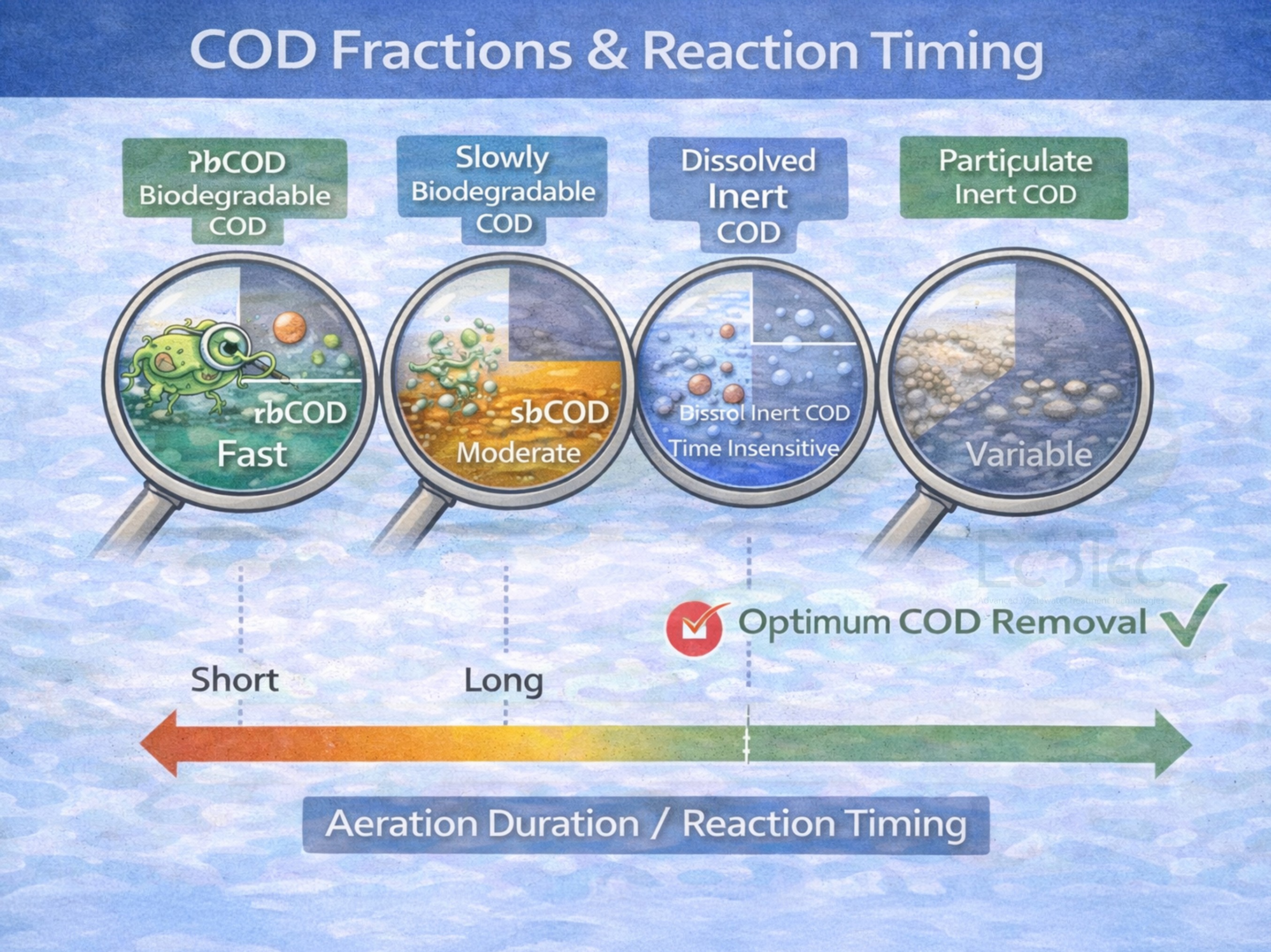
COD does not react all at once. Its fractions follow distinct timelines:
Readily biodegradable COD (rbCOD)
Reacts quickly, often early in the cycle.
Soluble biodegradable COD (sbCOD)
Reacts after rbCOD, but still relatively early.
Particulate biodegradable COD
Reacts only after hydrolysis, often much later.
Inert COD
Does not react at all.
If aeration is applied when:
rbCOD is already consumed, and
particulate COD has not yet hydrolysed,
then oxygen supply exceeds biological demand.
How Reaction Timing Explains “Unresponsive” COD
A common observation in STPs is:
“COD is not reducing even after long aeration.”
In many cases:
Oxygen is present
Blowers are running
DO levels are stable
But:
Biodegradable substrate is temporarily unavilable
Biology is waiting for hydrolysis
Remaining COD is inert
In such situations, aeration duration becomes irrelevant.
This is often mistaken for under-aeration, when the true limitation is reaction readiness.
Why Reaction Timing Matters for Nutrient Removal
Biological nitrogen removal depends on:
Carbon availability
Carbon being available at the right time
If biodegradable COD is consumed too early:
Nitrification may preceed
Denitrification lacks carbon
If COD becomes available too late:
Reaction windows are missed
Aeration duration alone cannot resolve this mismatch.
Only reaction-timed design can.
Why DO Can Be Misleading
Maintaining a target dissolved oxygen (DO) level is often treated as proof of adequate treatment.
However:
DO indicates oxygen presence
DO does not indicate reaction progress
DO does not indicate substrate availability
High DO may simply indicate that:
Biology has completed reactions
Or cannot proceed further
Thus, good DO does not guarantee effective treatment.
Reaction Timing vs Aeration Duration: A Simple Comparison
Designing with Reaction Timing in Mind
Designing for reaction timing requires:
Understanding COD fractions
Knowing when hydrolysis will release substrate
Aligning aeration phases with biological demand
This approach:
Reduces unnecessary aeration
Improves COD and nitrogen stability
Enhances long-term performance
Aeration duration then becomes an outcome, not a control variable.
How This Fits into the Knowledge Hub
This article builds directly on:
Aeration Does Not Treat Sewage — Biology Does
COD Decoding: Understanding What Is Really in Sewage
and prepares the foundation for:
Aeration Design Decision Matrix: Matching Aeration to Wastewater
What to Read Next
Conclusion:
Longer aeration does not guarantee better treatment.
It only increases energy consumption if biological reactions are already complete—or cannot yet occur.
Understanding when biology can react is far more important than deciding how long to aerate.
Reaction timing is not an operational tweak.
It is a design principle.