COD Decoding Starts at the Source of Wastewater
Why knowing where sewage comes from is the first step to designing a stable STP
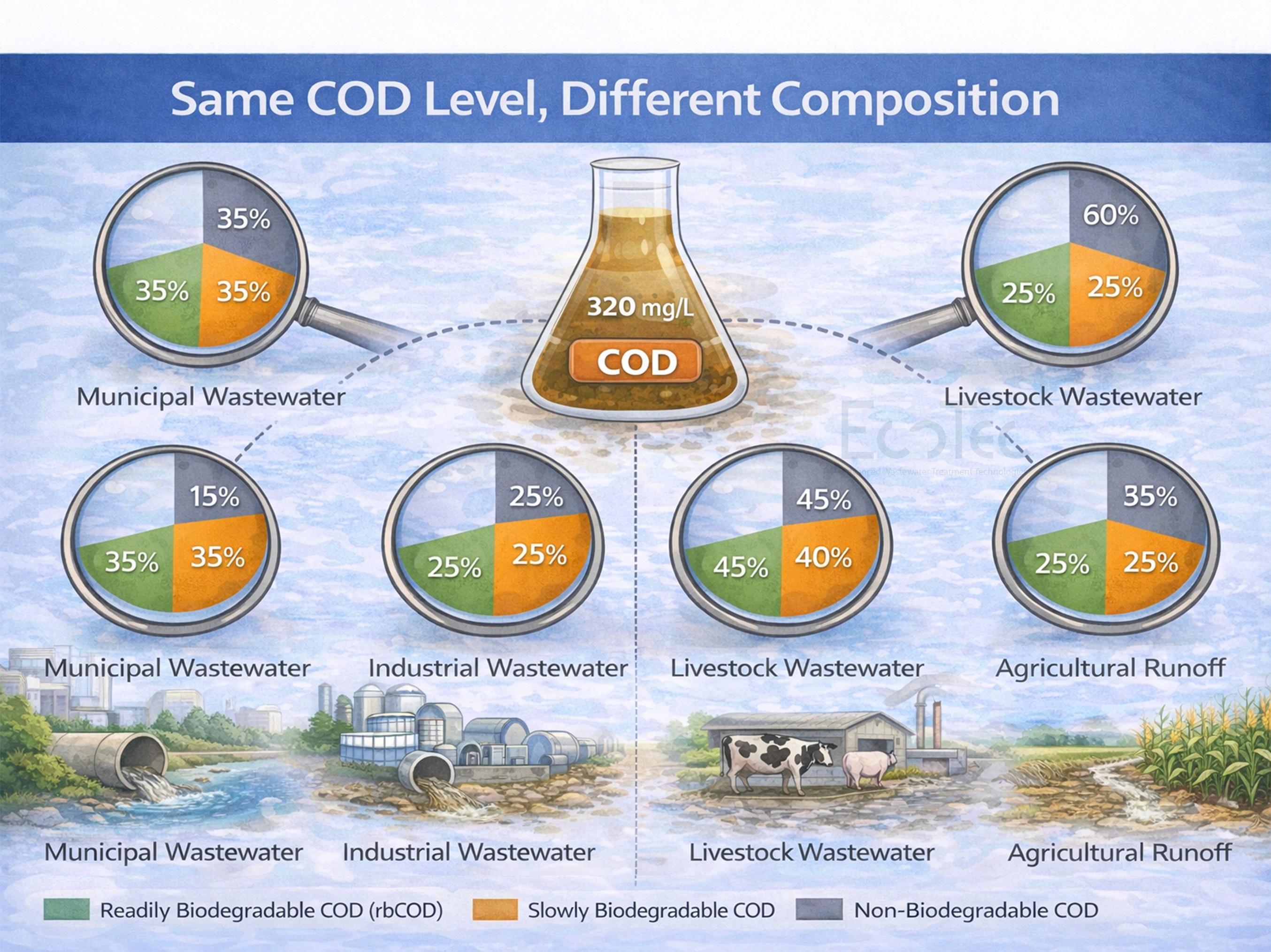
COD Does Not Behave the Same Everywhere
In sewage treatment plant (STP) design, wastewater is often treated as a single, uniform input—especially when it is labelled “domestic sewage” and evaluated only against discharge limits prescribed by the Central Pollution Control Board (CPCB).
In reality, wastewater behaviour is strongly influenced by its source.
Two wastewaters may show:
Similar BOD
Longer aeration does not reduce COD further
and yet behave very differently inside a biological treatment system.
This is because COD composition changes with source, and COD behaviour—not COD magnitude—governs biological treatment.
Why Source Matters More Than Numbers
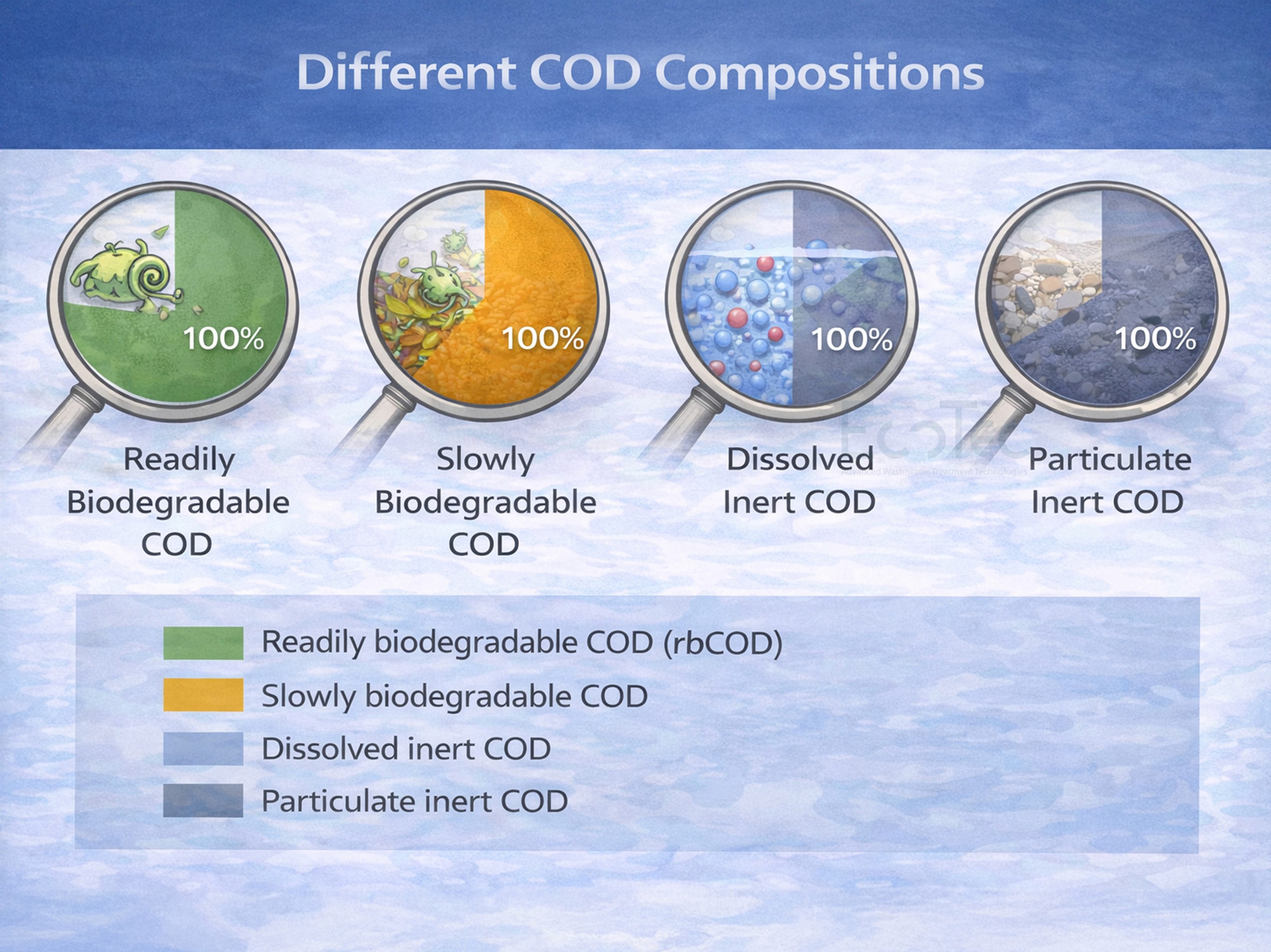
COD is a mixture of organic fractions.
The relative proportion of these fractions depends largely on where the wastewater originates.
Source determines:
How much COD is readily biodegradable
How much COD is particulate and hydrolysis-limited
How much COD is inert and non-removable
When oxygen demand will actually occur
Ignoring source means designing treatment systems based on averages, not behaviour.
Domestic Sewage: Predictable but Not Simple
Domestic sewage typically contains a balanced mix of organic matter from:
Human waste
Kitchen wastewater
Cleaning activities
Typical COD Characteristics
Moderate rbCOD
Moderate particulate biodegradable COD
Low to moderate inert COD
What This Means for Design
Biological reactions are reasonably predictable
Oxygen demand is spread over time
Nutrient removal is feasible if carbon is managed correctly
Domestic sewage is often considered “easy to treat,” but even here:
Ignoring COD fractions leads to over-aeration
Poor reaction timing affects nitrogen removal
Butchery Wastewater: Hydrolysis-Limited COD
Wastewater from butcheries and meat processing units is dominated by:
Fats, oils, and grease
Proteins and complex particulates
Typical COD Characteristics
High particulate biodegradable COD
Low readily biodegradable COD
Higher inert organic content
What This Means for Design
COD does not become immediately available to biology
Hydrolysis is the rate-limiting step
Oxygen demand appears late, not early
In such cases:
High initial aeration has little effect
Long aeration durations may still show slow COD reduction
This is often misinterpreted as “insufficient aeration,” when the real limitation is substrate availability.
Bakery Wastewater: Fast-Reacting COD
Bakery and confectionery wastewater typically contains:
Sugars
Starches
Easily soluble carbohydrates
Typical COD Characteristics
Very high rbCOD
Minimal particulate COD
Low inert COD
What This Means for Design
Oxygen demand is immediate and intense
Biological reactions occur rapidly
Peak oxygen demand occurs early
If aeration is designed for average load:
Early oxygen limitation occurs
Treatment efficiency drops despite long aeration periods
This wastewater highlights why reaction timing matters more than aeration duration.
Brewery Wastewater: Highly Variable and Shock-Driven
Brewery and fermentation wastewater is characterised by:
Alcohols
Volatile fatty acids
Residual sugars
Typical COD Characteristics
Very high rbCOD
Strong batch-to-batch variation
Sharp oxygen demand spikes
What This Means for Design
Equalisation becomes critical
Aeration must respond quickly to load changes
Fixed aeration strategies perform poorly
Without understanding source variability:
Biological systems experience stress
Performance fluctuates despite “adequate” capacity
This wastewater highlights why reaction timing matters more than aeration duration.
Why Similar COD Values Behave Differently
A domestic sewage stream and a bakery wastewater stream may both show:
Before biology can oxidise it, this particulate COD must be converted into soluble form through hydrolysis.
COD ≈ 500 mg/L
Yet:
One reacts steadily
The other reacts almost instantly
Designing both systems the same way leads to:
Energy waste in one case
Oxygen limitation in the other
This is why COD decoding must always begin with source identification.
Source-Based COD Decoding Improves Design Outcomes
When wastewater source is properly considered, designers can:
Predict reaction timing more accurately
Align aeration with actual oxygen demand
Decide whether equalisation is essential
Set realistic expectations for COD and nutrient removal
This moves STP design from generic to context-aware.
How This Connects to the Larger Design Picture
Understanding the wastewater source is the bridge between:
COD decoding
Aeration philosophy
Biological stability
👉 To see why aeration alone cannot compensate for source-driven COD behaviour, read:
What to Read Next
Conclusion
COD decoding does not start in the laboratory.
It starts by asking a simple question:
Where does the wastewater come from?
Answering that question correctly determines:
How biology will respond
When oxygen is actually needed
Whether treatment will be stable or stressed
Source-aware design is not an extra step.
It is the foundation of reliable sewage treatment.