Beyond BOD: Why Traditional Sewage Treatment Design Is No Longer Enough
Understanding why BOD-based design cannot deliver stable, efficient STPs
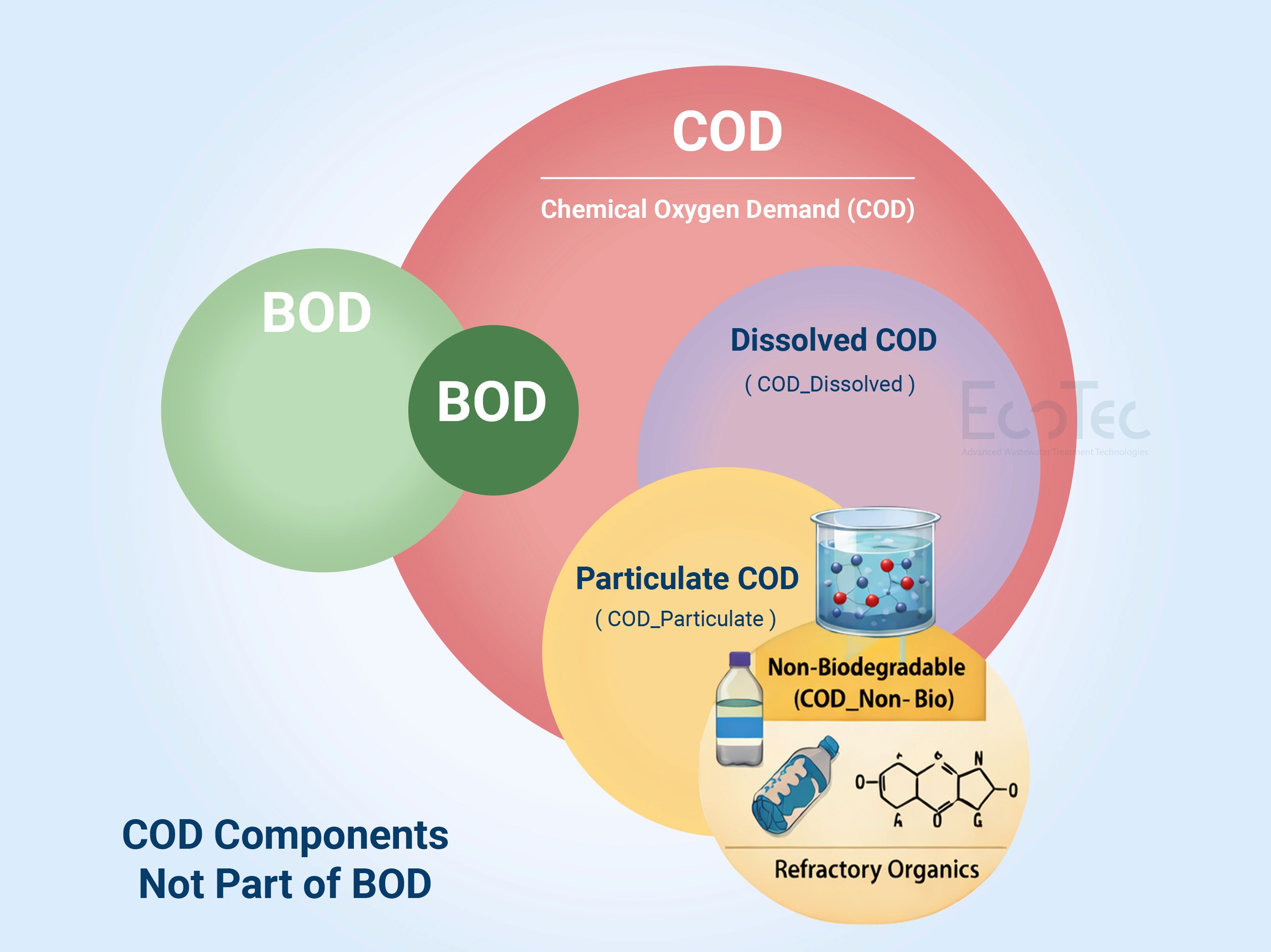
Why We Need to Go Beyond BOD
Biochemical Oxygen Demand (BOD) has been the cornerstone of sewage treatment plant (STP) design for decades. It is widely used, easy to measure, and firmly embedded in regulatory frameworks. Even today, BOD remains a key compliance parameter under norms issued by the Central Pollution Control Board (CPCB).
However, many STPs that meet BOD limits still:
Consume excessive energy
Show unstable COD or nitrogen removal
Degrade in performance over time
Require frequent operational correction
This raises an important question: If BOD compliance is achieved, why do so many STPs still underperform?
The answer lies in what BOD does not tell us.
What BOD Actually Represents
BOD measures the amount of oxygen required by microorganisms to biologically degrade biodegradable organic matter over a fixed test period (typically 5 days).
In simple terms, BOD tells us:
How much easily biodegradable organic matter is present
Whether treated water meets a regulatory limit
BOD is therefore:
Useful for compliance checking
Helpful for basic pollution control
But BOD was never intended to describe how sewage behaves inside a treatment system.
What BOD Does Not Tell Us
BOD provides no insight into several critical aspects of biological treatment:
How fast organic matter reacts
When oxygen demand actually occurs
How much organic matter is particulate or slowly biodegradable
How much organic matter is inert and non-biodegradable
Whether sufficient carbon is available for nutrient removal
As a result, two wastewaters with the same BOD can behave very differently in an STP.
Why BOD-Based Design Creates a False Sense of Security
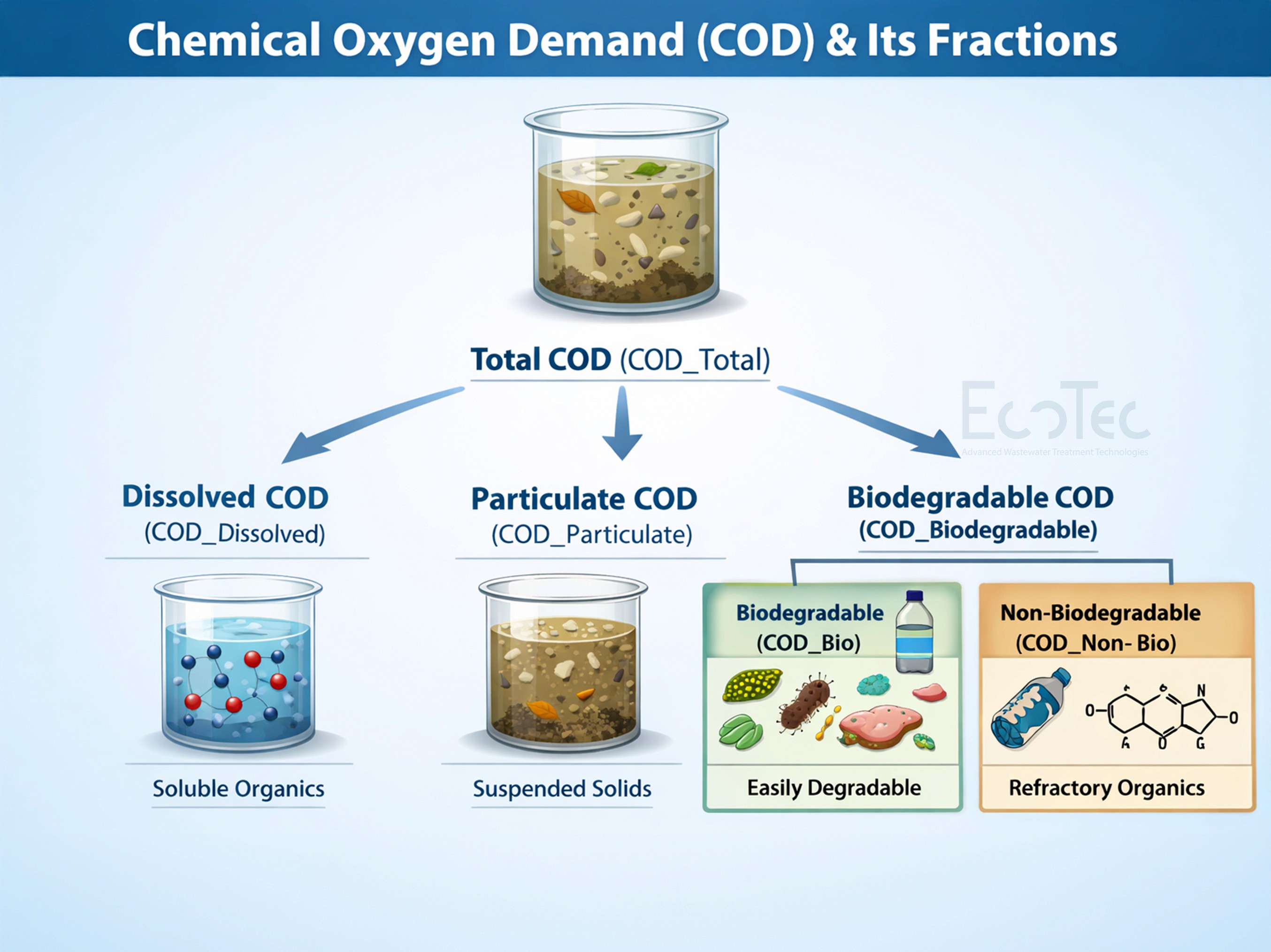
Chemical Oxygen Demand (COD) represents the total organic load, including:
Readily biodegradable organics
Slowly biodegradable and particulate organics
Inert, non-biodegradable organics
BOD typically captures only a fraction of this total load.
This explains why:
COD may remain high even when BOD is low
Nitrogen removal may fail despite good BOD performance
Sludge behaviour becomes unpredictable over time
Understanding COD behaviour is therefore essential for designing stable biological systems, not just compliant ones.
👉 This is explored further in:
The Link Between BOD, COD, and Real Performance
Modern STP challenges—such as nutrient removal, reuse quality, and energy efficiency—depend on factors that BOD does not describe:
Availability of carbon for denitrification
Timing of oxygen demand
Hydrolysis of particulate organics
Accumulation of inert COD
Designing only for BOD assumes that:
All organics behave similarly
Oxygen demand is uniform in time
Biology will adapt automatically
These assumptions no longer hold true under today’s regulatory and operational expectations.
Why Regulations Have Also Moved Beyond BOD
Regulatory evolution in India reflects this reality.
Over time, CPCB-aligned expectations have shifted:
From basic BOD reduction
To tighter COD control
To tighter COD control
This evolution did not happen arbitrarily. It occurred because BOD-compliant plants still failed to protect receiving water bodies.
👉 Read more in:
What Comes After BOD?
Moving beyond BOD does not mean discarding it.
It means placing BOD in its correct role:
BOD → compliance check
COD behaviour → design foundation
Biology → treatment mechanism
Aeration → enabling function
This shift allows STPs to be designed for:
Stability
Efficiency
Predictable performance
What to Read Next
To continue this learning path:
Conclusion
BOD has served the industry well as a regulatory benchmark, but it is no longer sufficient as a design driver.
Modern sewage treatment requires:
Understanding what BOD hides
Recognising how COD behaves
Designing biology first, not aeration first
Going beyond BOD is not a trend.
It is a necessary evolution in STP design thinking.