Aeration Design Decision Matrix: Matching Aeration to Wastewater
Why one aeration strategy cannot work for every STP
Why Aeration Needs a Decision Framework
After Understanding:
Why BOD alone is insufficient
How COD behaves differently by fraction and source
Why reaction timing matters more than aeration duration
one conclusion becomes clear:
Aeration cannot be designed as a fixed utility.
It must be designed as a response to wastewater behaviour.
This article translates earlier concepts into a simple decision matrix that helps designers choose how and when to aerate, based on wastewater type.
Why “Standard Aeration Design” Fails
Many STPs apply a uniform aeration approach:
Fixed blower sizing
Continuous or long-duration aeration
Design based on average BOD load
This approach assumes that:
All sewage behaves similarly
Oxygen demand is evenly distributed
Biology responds uniformly over time
As shown in earlier articles, these assumptions do not hold.
What the Aeration Decision Matrix Is Based On
Effective aeration design depends on three biological questions:
What type of COD dominates the wastewater?
When does that COD become biologically available?
How quickly does oxygen demand rise and fall?
The answers depend largely on wastewater source.
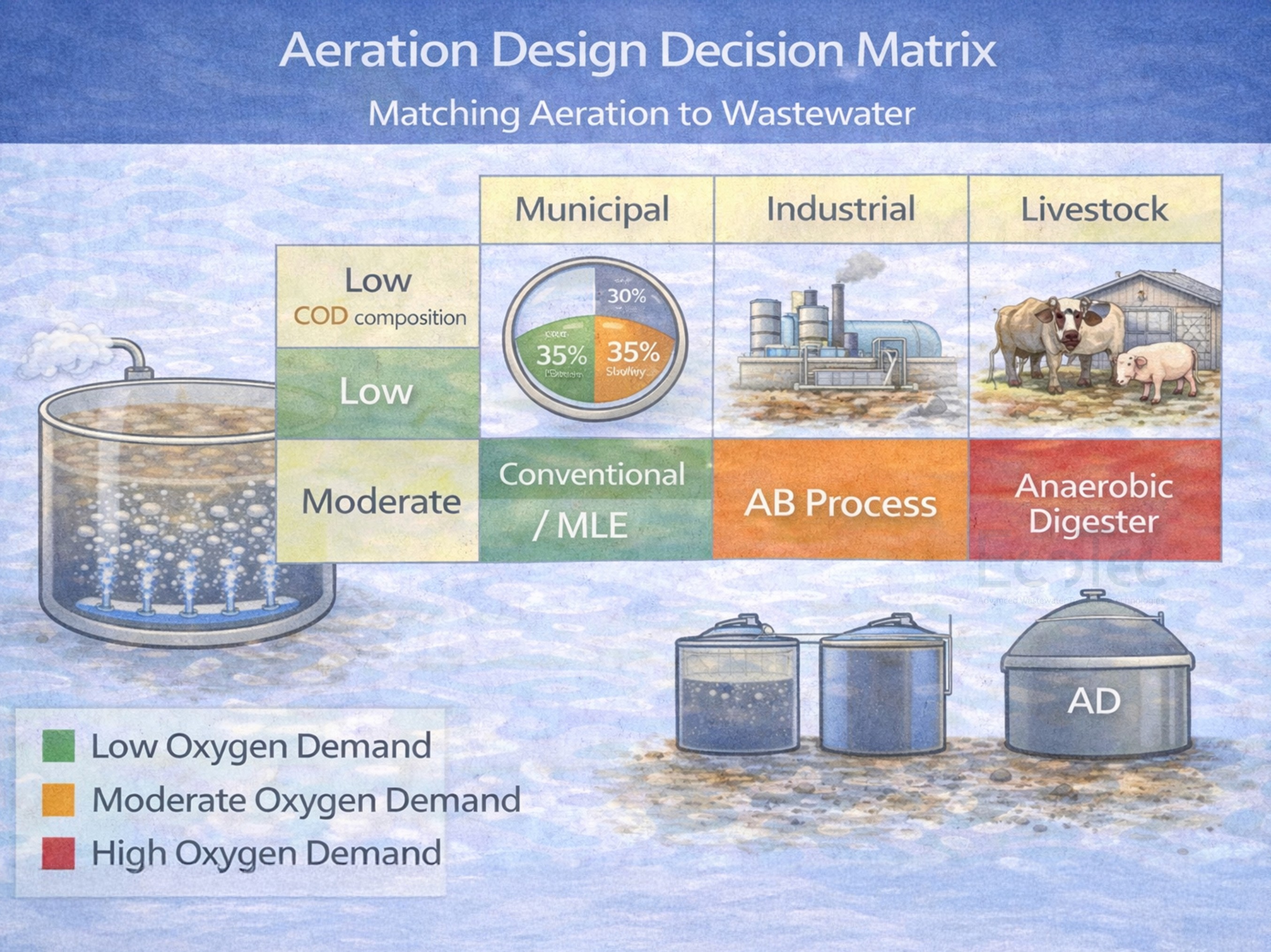
The Aeration Design Decision Matrix
How to Read This Matrix Correctly
This matrix does not suggest:
More aeration is always better
Longer aeration ensures treatment
Instead, it highlights that:
Timing matters more than total hours
Intensity matters more than continuity
Stability matters more than brute force
What Goes Wrong When the Matrix Is Ignored
Domestic Sewage Treated Like Industrial Waste
Excessive Aeration
Suppressed Denitrification
Energy Waste
Butchery Waste Treated Like Domestic Sewage
High Early Aeration
Slow COD Response
Misdiagnosed "Poor Aeration"
Bakery Waste Treated with Average Aeration
Early Oxygen Limtation
Incomplete Oxidation
Performance Instability
Brewery Waste Without Equalisation
Oxygen Demand Shocks
Biomass Stress
Fluctuating Effluent Quality
These failures are design mismatches, not operational mistakes.
Why DO Can Be Misleading
Maintaining a target dissolved oxygen (DO) level is often treated as proof of adequate treatment.
However:
DO indicates oxygen presence
DO does not indicate reaction progress
DO does not indicate substrate availability
High DO may simply indicate that:
Biology has completed reactions
Or cannot proceed further
Thus, good DO does not guarantee effective treatment.
Why This Matrix Improves Long-Term Performance
Using a source-based aeration matrix allows designers to:
Align aeration with biological demand
Reduce unnecessary blower runtime
Improve COD and nitrogen stability
Lower long-term operating costs
It also:
Makes performance more predictable
Reduces reliance on operator intervention
Aligns better with evolving regulatory expectations
How This Connects to Regulation
As expectations under the Central Pollution Control Board (CPCB) evolve toward:
Nutrient control
Reuse-quality effluent
Aeration strategies based on averages are increasingly insufficient.
Source-aware, reaction-timed aeration is becoming a design necessity, not an optimisation.
How This Fits into the Knowledge Hub
This article consolidates ideas from:
COD Decoding Starts at the Source of Wastewater
Reaction Timing vs Aeration Duration
and leads directly to:
How CPCB Expectations for Sewage Treatment Have Changed (2010–2025)
What to Read Next
Conclusion:
Aeration is not a one-size-fits-all solution
Designing aeration without considering:
Wastewater source
COD fraction behaviour
Reaction timing
results in systems that consume energy without delivering stability.
An aeration decision matrix grounded in biology converts aeration from a cost centre into a process enabler.