Industry Practice vs Design Reality in Sewage Treatment Plants
Why many STPs comply on paper but struggle in real operation
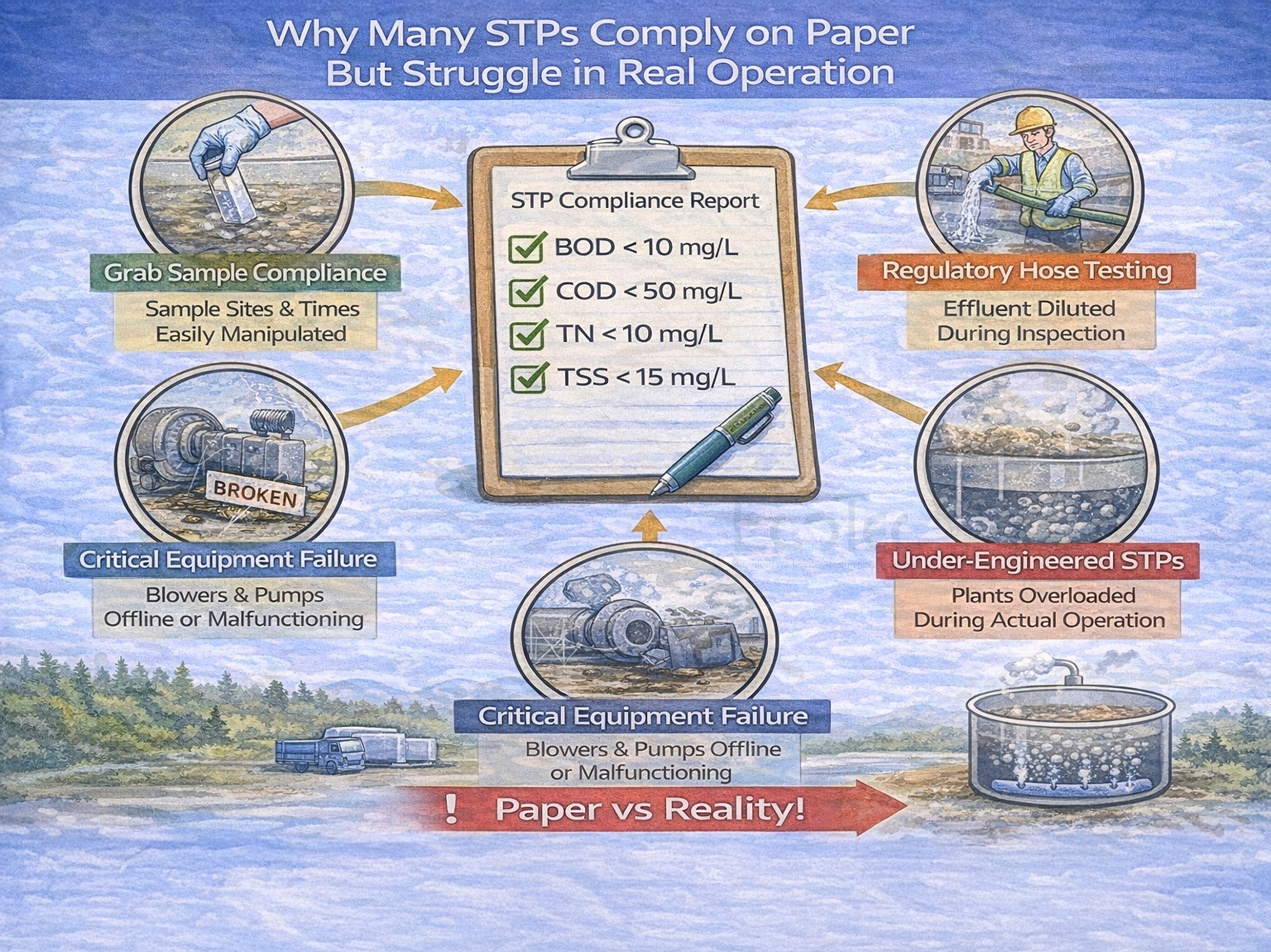
When Standard Practice Delivers Standard Problems
Across India, most sewage treatment plants (STPs) are designed, built, and evaluated using well-established industry practices. These practices are aligned with discharge norms issued by the Central Pollution Control Board (CPCB) and are widely accepted by consultants, vendors, and approving authorities.
Yet, despite following accepted norms, many STPs:
Show inconsistent COD and nitrogen removal
Consume more energy than expected
Require frequent operational correction
Degrade in performance over time
This highlights a growing gap between what is commonly practiced and what biological systems actually need to perform reliably.
What Industry Practice Typically Looks Like
In most projects, STP design follows a familiar pattern:
Fixed inlet assumptions based on “typical domestic sewage”
BOD used as the primary organic design parameter
COD treated as a secondary or reporting parameter
Aeration sized conservatively to ensure compliance
Performance judged mainly on outlet test results
This approach offers:
Simplicity
Ease of standardisation
Predictability during approval and commissioning
However, it also embeds several biological blind spots.
Design Reality: Biology Does Not Follow Assumptions
Biological treatment systems do not respond to:
Average values
Single-number parameters
Fixed time cycles
Instead, biology responds to:
COD fraction availability
Reaction timing
Stability of loading conditions
When design is driven primarily by BOD and averages, it assumes that:
All organic matter behaves similarly
Oxygen demand is uniform over time
Biology will adapt automatically
In reality, these assumptions often break down.
Gap 1: Inlet Assumptions vs Actual Wastewater Behaviour
Industry practice relies heavily on standard inlet values.
In reality:
Domestic sewage varies significantly by location and usage
Mixed-use developments introduce non-domestic COD fractions
Seasonal and diurnal variations alter reaction behaviour
When actual wastewater deviates from assumed characteristics:
Aeration strategies become misaligned
COD removal becomes unpredictable
Nutrient performance suffers
The plant still “meets design,” but struggles to perform.
Gap 2: What Is Committed vs What Governs Performance
Most STP suppliers commit to:
BOD
COD
TSS
pH
These are output parameters and are necessary for compliance.
However, they do not describe:
COD fraction behaviour
Reaction timing
Carbon availability for denitrification
Energy Efficieny
As a result:
Multiple plants meet identical commitments
Actual performance and operating cost vary widely
The difference lies not in commitments, but in design logic.
Gap 3: Aeration as Insurance, Not as a Process Tool
Industry practice often treats aeration as:
A safety margin
A means to absorb uncertainty
A way to “guarantee” compliance
This leads to:
Longer aeration durations
Higher blower capacities
Increased energy consumption
While this may help meet outlet numbers, it:
Masks biological inefficiencies
Does not improve reaction timing
Does not address COD fraction limitations
Aeration becomes an insurance policy—not a process enabler.
Gap 4: Nutrient Removal Treated as an Add-On
With evolving regulatory expectations, nutrient removal is increasingly required.
Industry response often involves:
Adding anoxic zones
Increasing aeration control complexity
Relying on operational adjustments
However, without understanding carbon availability and timing, these measures:
Deliver inconsistent results
Depend heavily on operator intervention
Increase system sensitivity
Nutrient removal cannot be reliably “added” to a BOD-designed system.
It must be designed into the biology from the start.
Why These Gaps Persist
These gaps are not due to negligence. They persist because:
Standardisation simplifies procurement
Conservative design reduces approval risk
BOD-based thinking is deeply ingrained
Biological behaviour is harder to explain than equipment capacity
However, as regulatory and performance expectations rise, these compromises become more visible.
The Cost of the Gap
When industry practice diverges from biological reality, the cost appears as:
Higher operating expenses
Lower resilience to load variation
Shorter intervals between interventions
Difficulty sustaining long-term compliance
These costs are rarely captured at design stage—but are paid throughout the plant’s life.
How This Leads to the Next Question
If:
Most vendors commit to similar numbers, and
Most plants are built using similar assumptions,
then the real question becomes:
What kind of design approach aligns industry practice with biological reality?
This leads directly to the final article in this series.
What to Read Next
Conclusion:
Industry practice has enabled rapid deployment of STPs and broad regulatory compliance.
However, long-term stability, energy efficiency, and nutrient control require a deeper alignment with biology.
Bridging the gap between practice and reality does not mean abandoning standards—it means evolving design thinking to reflect how sewage actually behaves.