EcoSBR in Context: Reaction-Driven Design vs Conventional STPs
How aligning treatment design with biological behaviour changes long-term performance
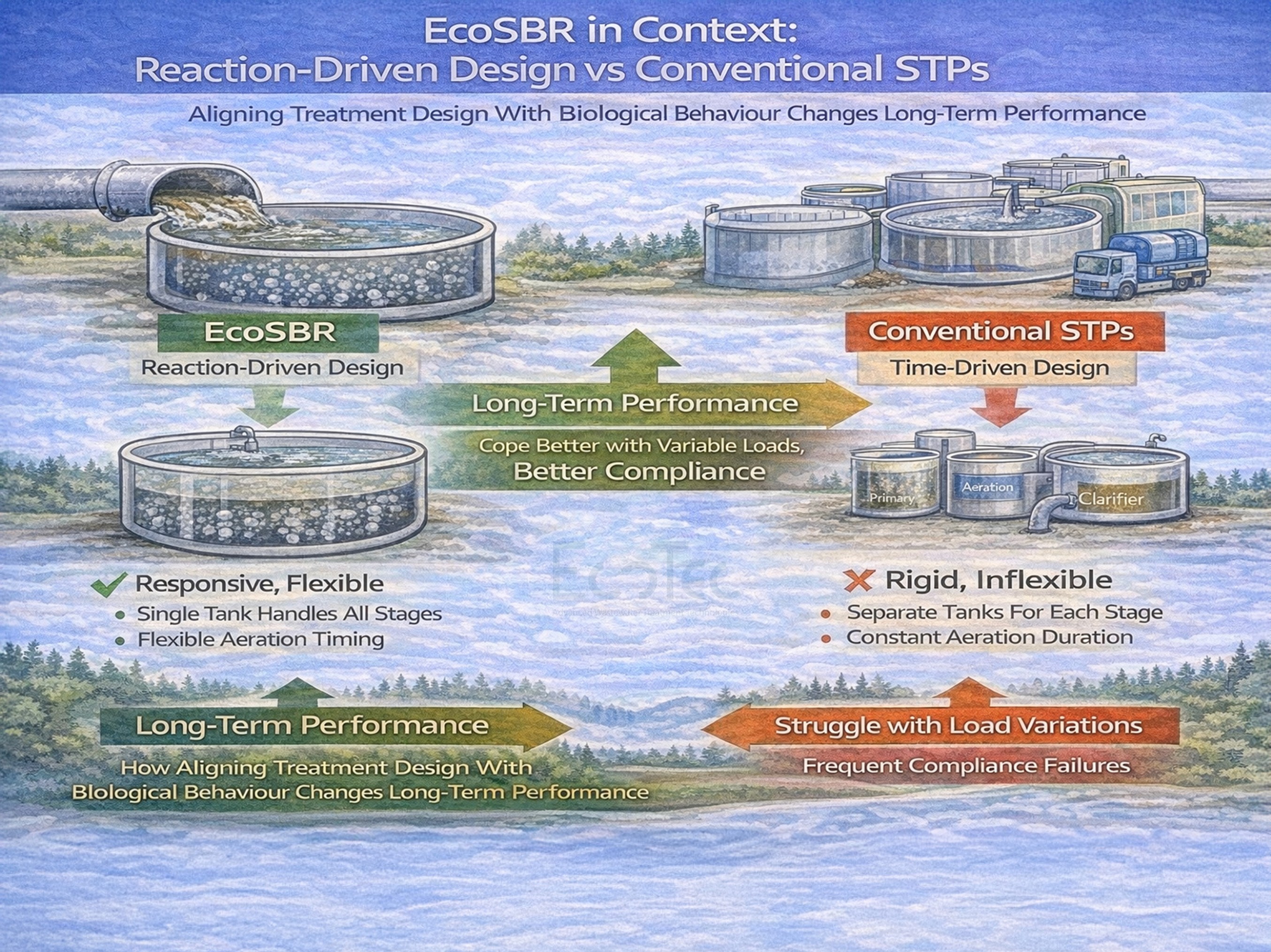
When Similar Outputs Hide Very Different Designs
On paper, most sewage treatment plants (STPs) promise similar outcomes:
BOD within limits
COD within limits
TSS under control
Whether the system is Johkasou, MBBR, conventional SBR, or EcoSBR, the committed treated water numbers often look identical and align with the requirements of the Central Pollution Control Board (CPCB).
Yet in real operation, performance differs significantly in terms of:
Energy consumption
Stability under load variation
Nitrogen removal consistency
Long-term sludge behaviour
These differences arise not from equipment alone, but from design philosophy.
Conventional STP Design: Time- and Load-Based Thinking
Most conventional STP designs—whether Johkasou, MBBR, or time-based SBR—share a common foundation:
Design driven primarily by BOD loading
Aeration sized conservatively to ensure compliance
Treatment cycles defined in fixed time blocks
Biological behaviour assumed, not explicitly analysed
This approach offers:
Simplicity
Ease of standardisation
Predictable approvals
Predictable approvals
Organic matter reacts uniformly
Oxygen demand is steady
Biology adapts automatically
As shown in earlier articles, these assumptions often fail under real conditions.
EcoSBR: A Reaction-Driven Design Approach
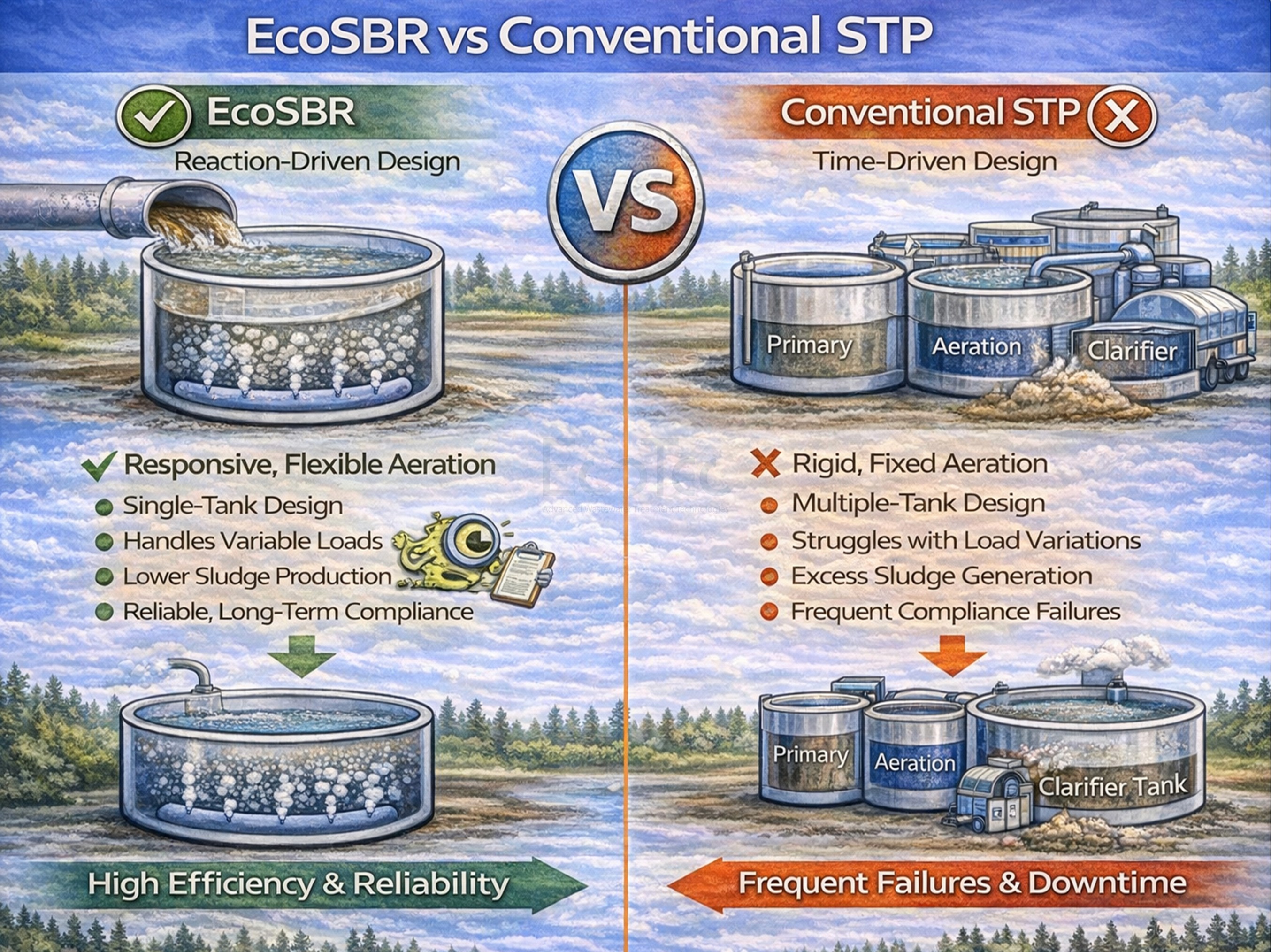
EcoSBR represents a shift away from time-based and aeration-led design toward reaction-driven biological design.
Instead of asking:
How many hours should we aerate?
EcoSBR asks:
When can biology actually react?
Which COD fractions are present?
When will oxygen demand occur?
This difference in questioning leads to a different design outcome.
How EcoSBR Differs at the Design Level
1. COD Behaviour Is Considered Early
EcoSBR design explicitly considers:
Readily biodegradable COD
Slowly biodegradable and particulate COD
Inert COD limits
This allows:
Realistic performance expectations
Better alignment between biology and aeration
Reduced reliance on correction during operation
2. Reaction Timing Drives Aeration Logic
In EcoSBR:
Aeration is aligned with biological demand
Oxygen is supplied when reactions can occur
Aeration duration becomes an outcome, not an assumption
This contrasts with conventional systems where:
Aeration follows preset schedules
Oxygen may be supplied when biology cannot use it
3. Biology Leads, Aeration Supports
EcoSBR treats:
Biology as the treatment mechanism
Aeration as an enabling function
This avoids:
Over-aeration as a safety margin
Masking of biological limitations
Energy consumption without proportional treatment benefit
4. Stability Is Designed In, Not Managed Later
By considering:
COD fractions
Reaction timing
Equalisation and hydrolysis
EcoSBR aims to deliver:
Stable COD removal
Predictable nitrogen behaviour
Lower sensitivity to daily fluctuations
This reduces dependence on:
Operator intervention
Continuous tuning
Emergency corrective actions
How This Compares with Other Technologies
This comparison is not about right vs wrong technology, but about design depth.
Why This Matters Under Today’s Expectations
As regulatory and stakeholder expectations evolve toward:
Stable COD control
Nutrient management
Reuse-quality effluent
Energy-conscious operation
STPs designed only to “meet numbers” face increasing stress.
Reaction-driven design aligns more naturally with:
Modern regulatory intent
Long-term operational realities
Environmental protection goals
How This Concludes the Knowledge Hub
This final article closes the loop created by the earlier ones:
Beyond BOD explains why old metrics are insufficient
COD Decoding explains what biology actually sees
Reaction Timing explains when treatment can occur
Aeration Design Matrix explains how to respond
Regulatory Evolution explains why this matters now
EcoSBR sits at the intersection of these ideas as a reaction-driven application of biological fundamentals.
Final Conclusion
Modern sewage treatment challenges cannot be solved by:
More aeration
Bigger equipment
Tighter time control
They are solved by:
Understanding COD behaviour
Respecting biological timing
Designing aeration to enable - not force - treatment
EcoSBR represents one such approach, grounded in the idea that biology must lead design.