Role of Collection Tank in Enhansing Aerobic Treatment rbCOD and sbCOD
Conversion of sbCOD to rbCOD Through Anaerobic Processes in a STP Collection Tank
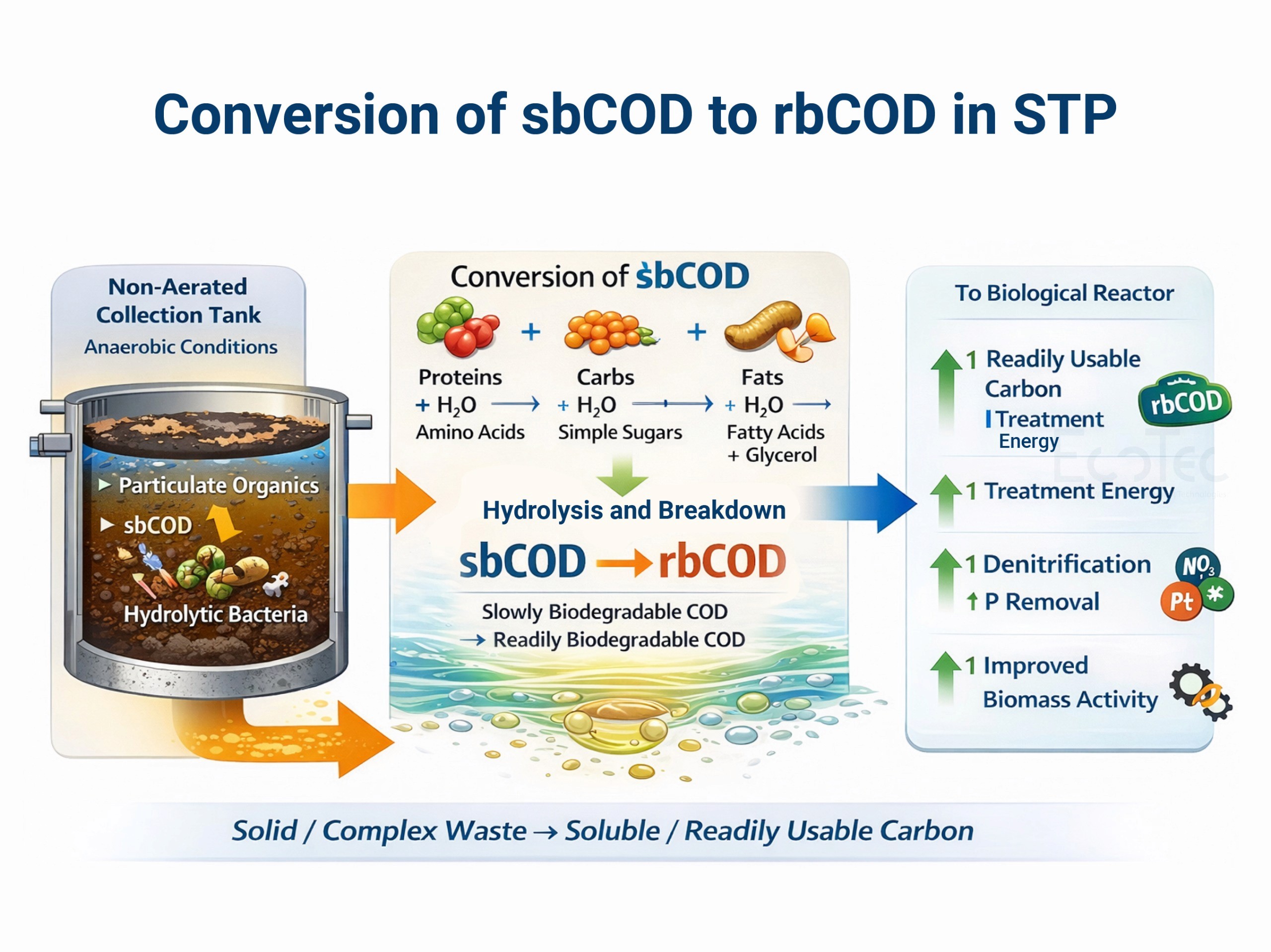
Anaerobic processes in a properly operated STP collection tank do not reduce treatment efficiency—on the contrary, they enhance it. By converting slowly biodegradable carbon into readily biodegradable carbon through hydrolysis, the collection tank prepares wastewater for efficient, stable, and economical downstream biological treatment.
Importance of Carbon Fraction Conversion in Sewage Treatment
In a sewage treatment plant (STP), treatment performance is governed not merely by total COD, but by the form in which organic carbon is present. A significant portion of raw sewage COD exists as slowly biodegradable COD (sbCOD), which is not immediately available for microbial uptake.
Efficient biological treatment—particularly nutrient removal and stable aerobic processes—requires a higher fraction of readily biodegradable COD (rbCOD). The conversion of sbCOD into rbCOD is therefore a critical preparatory step, and this conversion is naturally achieved through anaerobic processes in the collection tank when properly designed and operated.
Carbon Fractions in Raw Sewage
Raw municipal sewage typically contains:
rbCOD: Soluble, low-molecular-weight organics immediately available for microbial metabolism
sbCOD: Particulate or complex organics requiring enzymatic breakdown
Inert COD: Non-biodegradable fraction
In most STPs, sbCOD forms a substantial fraction of influent COD. Without conversion, this carbon remains biologically inaccessible during key treatment stages.
Role of the Collection Tank in sbCOD Conversion
The collection tank is often the first point of biological interaction within the STP. When operated under controlled anaerobic conditions, it becomes a carbon conditioning zone rather than a passive hydraulic structure.
Key operating characteristics include:
Absence of aeration
Short hydraulic retention time
Minimal mechanical mixing (only if required hydraulically)
No sludge accumulation
These conditions are ideal for initiating hydrolysis, the first and rate-limiting step in the breakdown of sbCOD.
Anaerobic Hydrolysis: Mechanism of sbCOD to rbCOD Conversion
Under anaerobic conditions, hydrolytic and fermentative microorganisms dominate. These microorganisms secrete extracellular enzymes that:
Break down particulate and complex organics
Convert proteins into amino acids
Convert carbohydrates into simple sugars
Convert fats into fatty acids
As a result, sbCOD is solubilised into smaller, low-molecular-weight compounds, thereby increasing the rbCOD fraction of the wastewater.
This conversion improves the biological availability of carbon without reducing total COD.
Why Anaerobic Conditions Are Essential for Effective Conversion
Anaerobic conditions favour sbCOD conversion because:
Oxygen is not available for direct oxidation
Carbon is conserved instead of being lost as CO₂
Fermentation pathways dominate over respiration
Hydrolysis proceeds efficiently without energy loss
In contrast, aeration in the collection tank promotes aerobic oxidation, which consumes rbCOD rather than creating it.
Difference Between Anaerobic Conditioning and Septic Digestion
It is important to distinguish between controlled anaerobic conditioning and septic conditions, as the outcomes are fundamentally different.
Anaerobic Conditioning (Desired)
Short retention time (hours)
Hydrolysis and limited fermentation
No methane generation
sbCOD converted to rbCOD
Wastewater remains biologically active
Septic Digestion (Undesirable)
Long retention time (days)
Methanogenesis and sulphide formation
Loss of biodegradable carbon
Production of inhibitory compounds
Poor feed quality for aerobic treatment
Only the former supports effective downstream biological processes.
Benefits of Increased rbCOD at the Aerobic Treatment Stage
By increasing rbCOD through anaerobic conversion in the collection tank, the STP achieves:
Improved heterotrophic biomass activity
Enhanced denitrification efficiency
Stable biological phosphorus removal
Reduced requirement for external carbon dosing
Better resilience to hydraulic and organic load variations
This directly translates into improved treatment stability and lower operating cost.
Designing collection tank for STPs
The collection tank should be intentionally designed and operated as a biological conditioning zone, not as an aerated mixing tank or a digestion. This approach ensures maximum conversion of sbCOD to rbCOD, unlocking the full biological potential of incoming sewage.