Hydrolysis Preferred in Collection Tank for Better STP Treatment
Hydrolysis and It's Role in Efficient Sewage Treatment
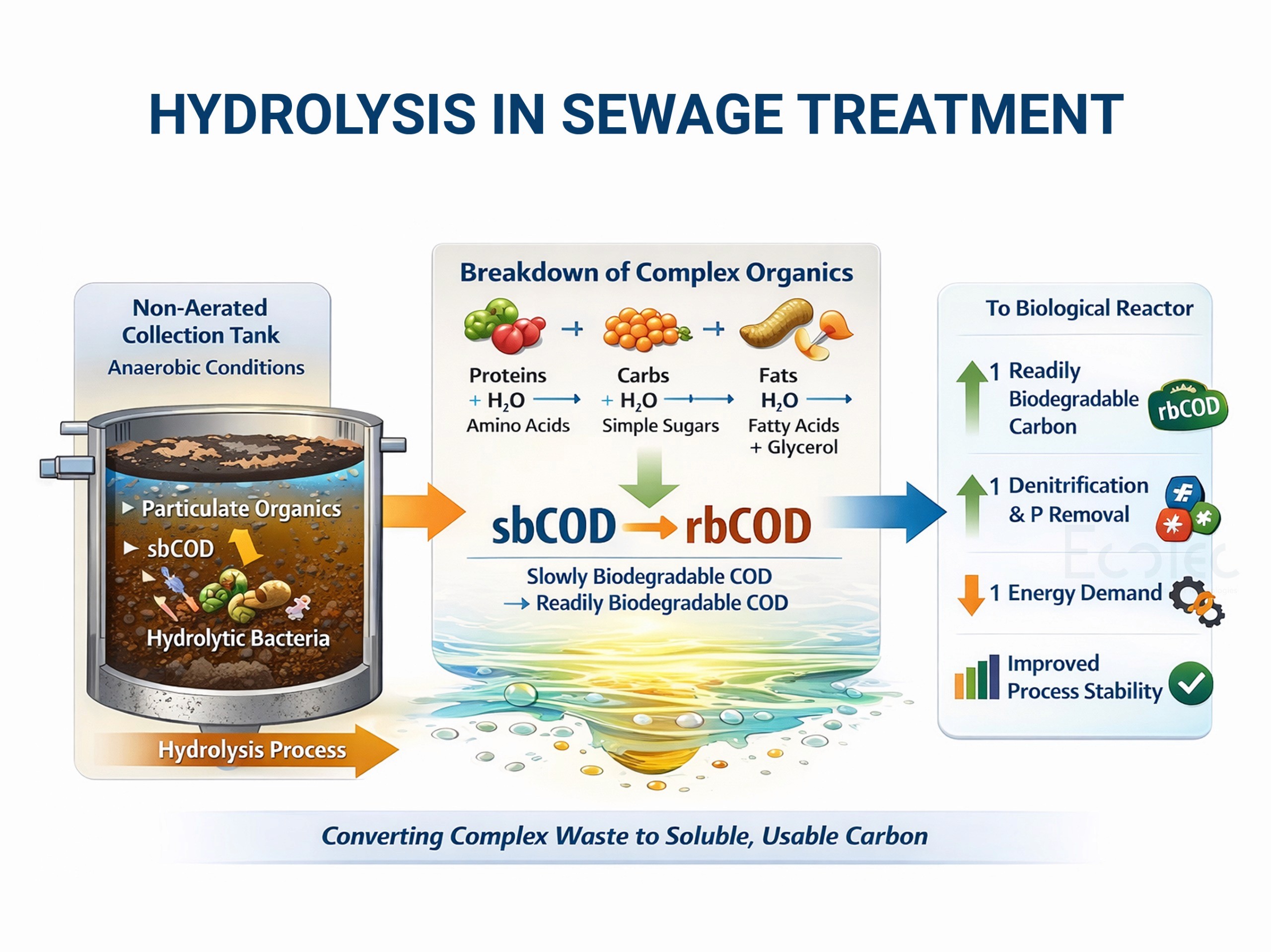
What Happens When Sewage Undergoes (and Does Not Undergo) Hydrolysis in the Collection Tank
Efficient biological sewage treatment depends not only on the quantity of organic matter present, but on how usable that organic matter is for microorganisms. One of the most critical and often overlooked processes that determines this usability is hydrolysis.
At EcoTec, hydrolysis is recognised as a foundational biological step that begins in the collection tank, provided it is designed and operated correctly.
What Is Hydrolysis in Sewage Treatment?
Hydrolysis is the biochemical breakdown of complex, particulate, and slowly biodegradable organic matter into simpler, soluble compounds that microorganisms can readily consume.
In raw sewage, a large fraction of organic matter exists as:
Particulate solids
High-molecular-weight compounds
Slowly biodegradable COD (sbCOD)
These forms cannot be directly utilised by most treatment microorganisms. Hydrolysis converts them into readily biodegradable COD (rbCOD).
Hydrolysis is widely recognised as the rate-limiting step in biological wastewater treatment.
What Happens During Hydrolysis in the Collection Tank
When sewage enters a non-aerated collection tank, the following sequence occurs:
Dissolved oxygen is rapidly depleted
Hydrolytic and fermentative bacteria become dominant
Enzymes break down complex organic matter
Particulate and slowly biodegradable matter is solubilised
The rbCOD fraction of sewage increases
Importantly, carbon is not destroyed during this process—it is converted into a biologically usable form.
Hydrolysis Explained with Simple Biochemical Representation
This transformation represents the conversion of sbCOD → rbCOD.
Why Anaerobic Conditions Favour Hydrolysis
Hydrolysis is favoured under anaerobic conditions because:
Oxygen is not available for direct oxidation
Microorganisms shift from respiration to enzymatic breakdown
Carbon is conserved instead of being lost as CO₂
Fermentation pathways dominate over oxidation pathways
In contrast, aeration in the collection tank suppresses hydrolysis by oxidising rbCOD as soon as it is formed.
What Happens When Hydrolysis Does NOT Occur?
A Critical Comparison
To fully understand the value of hydrolysis, it is important to examine cases where hydrolysis is absent or suppressed.
Case 1: Aerated Collection Tank (No Hydrolysis)
What happens upstream:
Readily biodegradable carbon is oxidised immediately
sbCOD remains largely unconverted
Carbon is lost as CO₂
Impact downstream:
Carbon-limited biological reactor
Poor denitrification
Unstable phosphorus removal
Higher aeration energy demand
Frequent need for external carbon dosing
Outcome:
The biological system works harder but achieves less.
Case 2: Direct Transfer Without Conditioning
What happens upstream:
No time for hydrolysis
Particulate organics enter the reactor unchanged
Hydrolysis shifts into the aeration tank (inefficient zone)
Impact downstream:
Delayed biological response
Localised oxygen demand spikes
Uneven biomass activity
Outcome:
Treatment becomes reactionary rather than controlled.
Case 3: Septic Conditions (Over-Anaerobic)
What happens upstream:
Excessive retention time
Methanogenesis and sulphide formation
Destruction of biodegradable carbon
Formation of inhibitory reduced compounds
Impact downstream:
Poor oxygen transfer
Inhibition of nitrifying bacteria
Odour and corrosion issues
Long recovery times
Outcome:
Biology is compromised before treatment begins.
Hydrolysis vs No Hydrolysis: Clear Comparison
Downstream Benefits When Hydrolysis Is Achieved
When hydrolysis is allowed to occur in the collection tank, downstream treatment benefits include:
Faster and more stable biological reactions
Improved nitrogen and phosphorus removal
Reduced aeration energy
Lower excess sludge production
Better tolerance to load fluctuations
These advantages are especially important in small and decentralised STPs, where process margins are limited.