COD and Its Fractions
Beyond BOD: Why COD Fractionation Is Essential for Modern CPCB-Compliant Sewage Treatment Plant Design
For a very long time, Biochemical Oxygen Demand (BOD₅) has been the primary parameter used to design sewage treatment plants (STPs) in India. This approach evolved during a time when sewage characteristics were relatively uniform, treatment systems were large and civil-intensive, and operational optimisation was not a priority.
Today, however, sewage treatment has entered a new phase. Decentralised plants, modular package systems, SBRs, MBBRs, and high-rate biological processes demand greater design precision and better alignment with actual biological behaviour.
While BOD continues to remain a mandatory regulatory compliance parameter under the norms prescribed by the Central Pollution Control Board (CPCB), its role as a primary biological design parameter is increasingly limited. This has led to the adoption of COD fractionation, including soluble and insoluble COD components, as a more robust basis for modern STP design.
Why BOD Alone Is No Longer Sufficient
BOD₅ measures the oxygen demand exerted by biodegradable organic matter over a fixed five-day laboratory test period. While useful for compliance reporting, BOD does not provide insight into:
Sludge yield and settleability behaviour
As a result, STPs designed purely on BOD often suffer from:
High energy consumption
Excess sludge generation
These limitations become more pronounced in compact and modular treatment systems with shorter hydraulic retention times (HRTs).
Understanding COD Fractionation
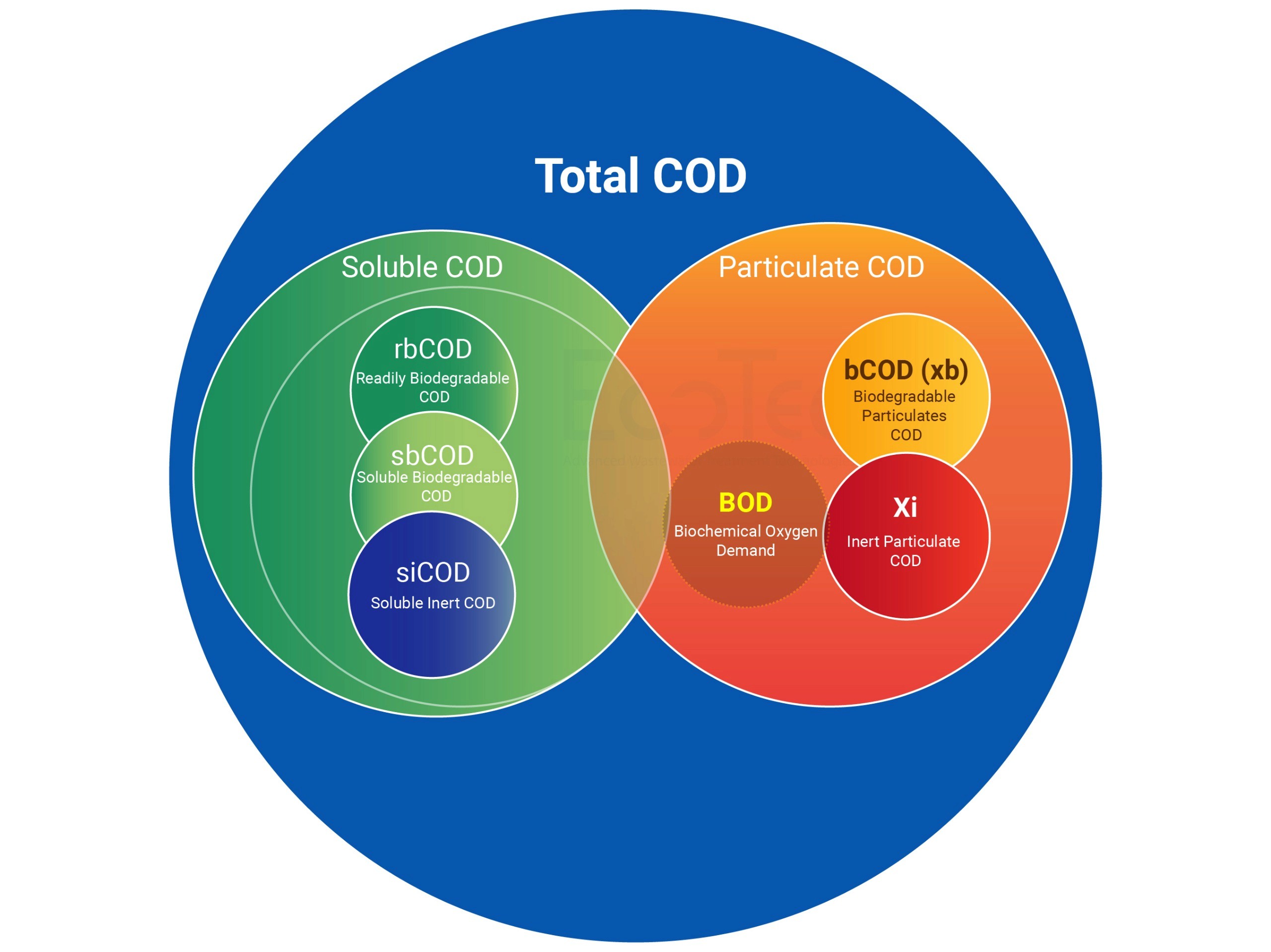
Chemical Oxygen Demand (COD) represents the total oxygen equivalent of organic matter present in sewage. Unlike BOD, COD can be fractionated to reflect how different organic components behave biologically.
Total COD (TCOD)
TCOD is divided into soluble COD and particulate (insoluble) COD, each influencing treatment performance in distinct ways.
Soluble COD and Its Sub-Fractions
Soluble COD is the fraction that passes through a 0.45 µm filter.
Readily Biodegradable COD (rbCOD)
Rapidly consumed by heterotrophic microorganisms
Provides the primary carbon source for denitrification
Plays a key role in biological nutrient removal (BNR) and aerobic granular sludge formation
Soluble Biodegradable COD (sbCOD)
Includes rbCOD and other soluble organics that degrade within short time frames
Supports microbial growth and oxygen uptake dynamics
Soluble Inert COD (siCOD)
Non-biodegradable
Passes through biological systems unchanged
Determines the minimum achievable effluent COD, regardless of process efficiency
Insoluble (Particulate) COD and Its Significance
Particulate or insoluble COD is retained on a 0.45 µm filter and is often underestimated in conventional designs.
Biodegradable Particulate COD (bCOD or Xb)
Requires hydrolysis before it can be utilised by microorganisms
Hydrolysis is significantly slower than soluble substrate uptake
Governs the required sludge retention time (SRT) and biological stability
Inert Particulate COD (Xi)
Non-biodegradable solids
Directly contributes to sludge production
Influences sludge handling, dewatering, and disposal costs
In Indian sewage, particulate and inert fractions are often high due to grit, suspended solids, and non-biodegradable domestic inputs, making this fraction especially important.
Why Insoluble COD Is Critical in Modern STP Design
In compact and high-rate systems, hydrolysis of particulate COD often becomes the rate-limiting step. BOD does not capture this delay, leading to overestimation of biological reaction rates and underestimation of required SRT.
Ignoring insoluble COD can result in:
Poor settleability
Frequent sludge withdrawal
Instability during load fluctuations
COD fractionation explicitly accounts for these factors, enabling more reliable designs.
Benefits of COD Fractionation in CPCB-Compliant Design
Improved Nitrogen Removal
CPCB norms increasingly emphasise ammonia and total nitrogen control. Denitrification requires readily available carbon, which is accurately quantified only through rbCOD and sbCOD assessment.
Aeration and Energy Optimisation
By distinguishing fast and slow biodegradable fractions:
Aeration can be aligned with actual biological demand
Over-aeration associated with conservative BOD assumptions is avoided
Energy consumption and blower sizing are optimised
Predictable Sludge Generation
Inert particulate COD directly determines sludge production. Accounting for this fraction allows better planning of sludge handling systems and lifecycle costs.
Stability in Modular and Package STPs
COD fractionation enables:
Accurate SRT selection
Stable operation under variable influent conditions
Improved performance of SBR, MBBR, and granular sludge systems
Relationship Between COD Fractionation and CPCB Parameters
While CPCB standards continue to specify BOD, COD, TSS, and nutrient limits for compliance, COD fractionation serves as a design and optimisation tool, not a replacement for regulatory parameters.
BOD: Compliance and reporting
COD: Identification of treatable vs inert organics
Nitrogen Limits: Dependent on rbCOD availability
TSS and Sludge: Influenced by particulate COD fractions
A Practical Design Philosophy for Indian STPs
A modern, CPCB-aligned approach integrates both regulatory and biological perspectives:
Design Basis: COD fractionation (rbCOD, sbCOD, bCOD, Xi)
Operational Control: Phase-based aeration, SRT management
Compliance Reporting: BOD, COD, TSS as per CPCB norms
This approach bridges the gap between what regulators measure and how biological systems actually function.
BOD remains an essential compliance parameter, but it is no longer sufficient as a standalone basis for designing modern sewage treatment plants. Incorporating soluble and insoluble COD fractionation enables predictable performance, energy efficiency, and long-term stability—particularly under Indian sewage conditions.
As sewage treatment technologies evolve, design methodologies must evolve alongside regulatory frameworks, ensuring that CPCB compliance is achieved through scientifically sound and operationally robust systems.