Nitrogen Removal in STPs & EcoSBR Advantages

Nitrification is a two-step aerobic biological oxidation process where ammonia (NH₄⁺) is converted first into nitrite (NO₂⁻) by ammonia-oxidizing bacteria (AOB), and then nitrite is converted into nitrate (NO₃⁻) by nitrite-oxidizing bacteria (NOB). This conversion is crucial because ammonia cannot be denitrified directly. Full nitrogen removal requires both nitrification and denitrification.

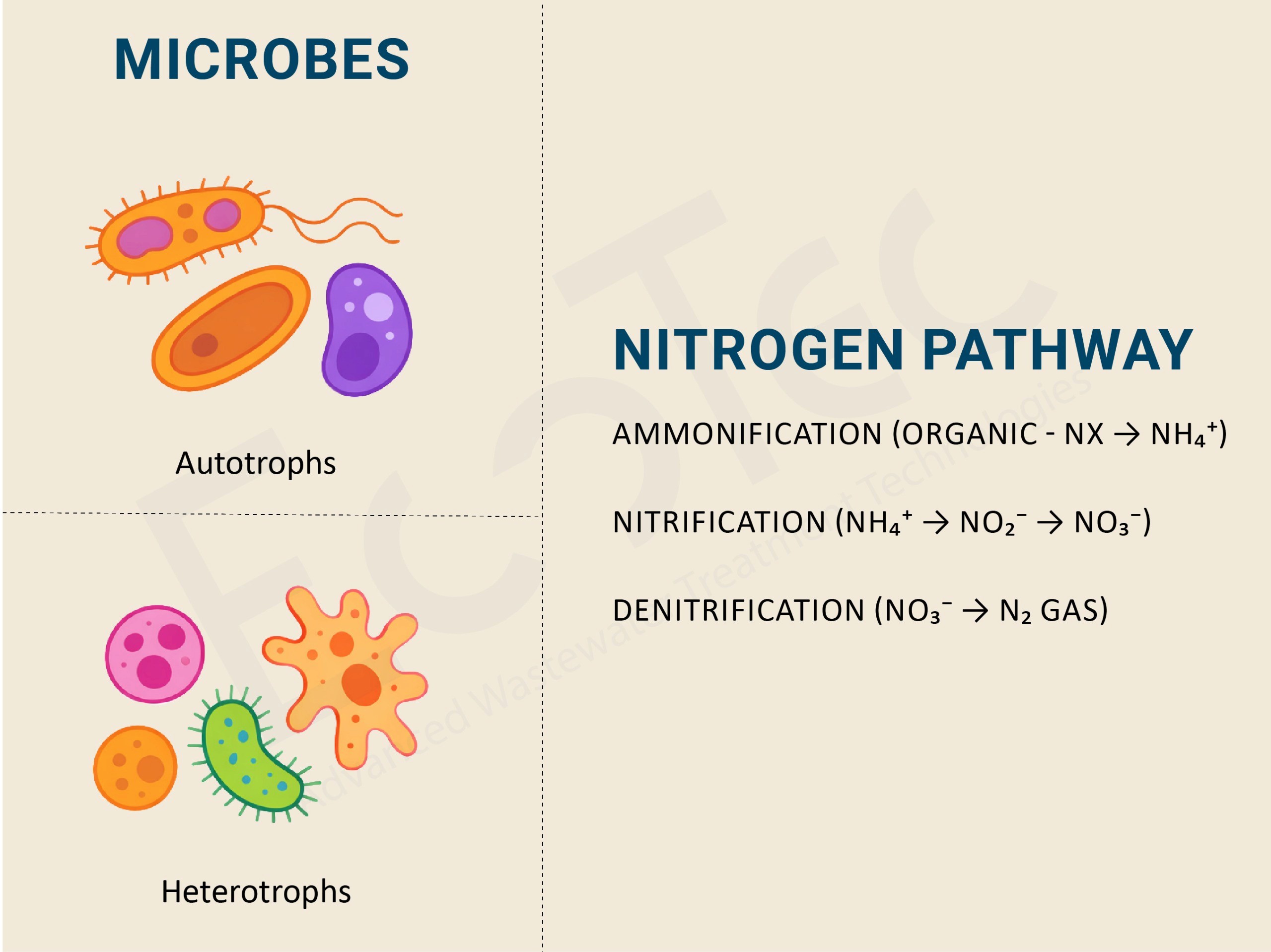
Organic - N → NH4+ → NO2- → NO3- → N₂ gas
Process

Ammonification (Organic-N → NH4+)

Nitrification (NH4+ → NO2- → NO3-)

Denitrification (NO3- → N2 gas)

Process Basics

Anaerobic

Aerobic

Anoxic

Where it happens

Collection Tank/ Anaerobic Tank

EcoSBR Reactor/ Aerobic Tank

EcoSBR Reactor

Process

Ammonification (Organic-N → NH4+)

Nitrification (NH4+ → NO2- → NO3-)

Denitrification (NO3- → N2 gas)

Process Basics

Anaerobic

Aerobic

Anoxic

Where it happens

Collection Tank/ Anaerobic Tank

EcoSBR Reactor/ Aerobic Tank

EcoSBR Reactor

Nitrogen removal process in sewage treatment plants using EcoSBR technology, showing ammonification, nitrification, and denitrification pathways for effective biological nitrogen removal.
Microbial Groups Performing Nitrification
Process

Ammonification (Organic-N → NH4+)

Nitrification (NH4+ → NO2- → NO3-)

Denitrification (NO3- → N2 gas)

Process Basics

Anaerobic

Aerobic

Anoxic

Where it happens

Collection Tank/ Anaerobic Tank

EcoSBR Reactor/ Aerobic Tank

EcoSBR Reactor

Process

Ammonification (Organic-N → NH4+)

Nitrification (NH4+ → NO2- → NO3-)

Denitrification (NO3- → N2 gas)

Process Basics

Anaerobic

Aerobic

Anoxic

Where it happens

Collection Tank/ Anaerobic Tank

EcoSBR Reactor/ Aerobic Tank

EcoSBR Reactor

The microbial groups involved:

  • Ammonia-Oxidizing Bacteria (AOB): Nitrosomonas, Nitrosospira

  • Nitrite-Oxidizing Bacteria (NOB): Nitrobacter, Nitrospira (dominant)

These bacteria are autotrophic, slow-growing, and sensitive to dissolved oxygen, pH, temperature, and toxins.

Development Timeline of Autotrophs in a New STP

Autotrophs (AOB & NOB) grow extremely slowly. Typical timeline in a new plant:

  • Days 1–3: Heterotrophs dominate, BOD reduces


  • Days 4–10: AOB begin developing, nitrite appears


  • Days 10–20: Stronger ammonia oxidation


  • Days 20–30: NOB appear → nitrate formation


  • Days 30–45: Full nitrification stabilizes


  • Days 45–60: Robust and stable nitrifying community

High DO is essential for this development.

Impact of High Ammonia & C:N Ratio

High ammonia concentration, especially from urine-heavy wastewater, requires a strong nitrifying capacity. However, office wastewater often has very low COD (lack of kitchen waste), leading to very low C:N ratios (1:1 or 2:1). This limits denitrification and causes nitrate buildup unless an SBR cycle promotes endogenous carbon usage.

Case Studies: Office Buildings

Office buildings without kitchens produce high nitrogen and very low COD wastewater. Urine dominates pollutant load, and carbon deficiency makes denitrification difficult. Office buildings with kitchens have better C:N balance and achieve better nitrogen removal.

EcoSBR manages both scenarios by using endogenous respiration and granular sludge.

Nitrogen Removal Pathway in EcoSBR

EcoSBR completes ammonification, nitrification, and denitrification within a timed sequence. High DO aeration ensures nitrification, followed by anoxic phases after filling and through intermittent aeration enabling complete denitrification.

EcoSBR Granular Sludge Advantages

EcoSBR naturally forms granular sludge due to selective pressure from its sequencing phases.

Benefits include:

  • Aerobic outer layer for nitrification


  • Anoxic inner core for denitrification


  • High settling velocity


  • Excellent retention of AOB and NOB


  • Simultaneous nitrification and denitrification (SND)

  • Aerobic outer layer for nitrification


  • Anoxic inner core for denitrification


  • High settling velocity


  • Excellent retention of AOB and NOB


  • Simultaneous nitrification and denitrification (SND)